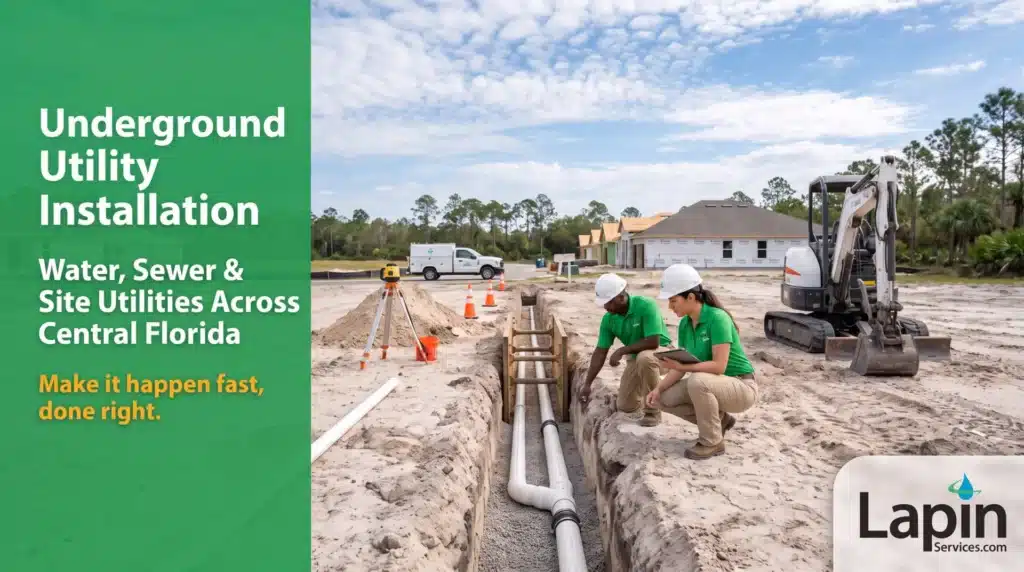
A new construction site needs four utility systems installed underground before vertical work can proceed: potable water, sanitary sewer, storm drainage, and dry utility conduit for power, gas and communications. Water, sewer and storm are the wet utilities, and they carry the permitting, inspection and tie-in requirements that set your schedule. Site utilities for new construction are the first trade in and the last one anyone thinks about until they hold up a certificate of occupancy.
Lapin Services has been installing underground infrastructure in Central Florida since 1958. This guide covers what gets installed, in what order, who inspects it, and where Orlando-area projects most often lose time.
What Counts as Site Utilities
Site utilities are everything buried between the public main and the building pad. On a typical Central Florida commercial or residential site, that means the following systems.
- Potable water: the water main tap, meter assembly, backflow prevention, domestic service line and fire service line to the riser.
- Sanitary sewer: gravity mains, laterals, manholes, cleanouts and, where elevation does not cooperate, a lift station and force main.
- Storm drainage: inlets, catch basins, reinforced concrete or HDPE pipe, control structures and the outfall to a retention or detention pond.
- Septic and onsite treatment: on unsewered parcels, a drainfield or onsite treatment and disposal system sized to the building’s projected flow.
- Dry utility infrastructure: conduit, sleeves and vaults for electric, gas, fiber and telecom, usually installed by the wet utility contractor and turned over to the providers.
Wet and dry utilities share the same corridor, so they compete for the same vertical space. That conflict is where coordination pays for itself.
The Order of Operations on a Central Florida Site
Utility work follows a sequence. Skipping ahead usually means excavating something twice.
- Design and utility research. Confirm the point of connection with the utility authority, verify main size and available pressure, and pull existing as-builts.
- Permitting and plan review. Submit to the county or municipal utility, the health department where septic is involved, and the water management district for stormwater.
- Locating and subsurface investigation. Mark existing lines, then verify the critical crossings by hand or vacuum excavation rather than trusting a paint mark.
- Clearing, erosion control and rough grading. Silt fence and inlet protection go in before the first trench opens.
- Deep utilities first. Storm and sanitary sewer run deepest, so they are installed before shallower water and conduit.
- Water and dry utility conduit. Water main, services, fire line and sleeves follow, crossing above the gravity systems.
- Testing and inspection. Pressure test the water, bacteriological clearance, sewer air or vacuum test, mandrel test and video inspection of gravity lines.
- Backfill, compaction and as-builts. Density testing, record drawings and utility turnover close out the phase.
On projects with a fire line, plan the water tie-in early. Fire flow testing and hydrant acceptance are frequently the last items standing between a finished building and occupancy.
Water Line Installation and the Main Tap
The water main tap installation is the single most schedule-sensitive item in the water scope. It requires coordination with the utility authority, a road-cut or right-of-way permit if the main sits under pavement, and often a wet tap performed while the main stays in service so existing customers keep water.
Three details decide whether the tap goes smoothly:
- Verified main size and material. Older Central Florida mains may be cast iron, asbestos cement or PVC, and each is tapped differently.
- Available pressure and flow. A fire line sized on assumed pressure can fail acceptance testing after everything is buried.
- Backflow and meter placement. The assembly must sit where the utility can read and service it, clear of parking, landscaping and future pavement.
Domestic Versus Fire Service
Domestic and fire service usually leave the main as separate taps with separate backflow requirements. Combining them to save one tap sounds efficient until plan review rejects it. Confirm the local utility standard before design, because requirements differ between Orange County, Orlando, Seminole County and the smaller municipal systems.
Sanitary Sewer: Gravity, Force Main or Septic
Sewer design starts with elevation. Gravity is always the preferred answer because it has no moving parts, but Central Florida’s flat topography and high water table often rule it out.
When the building’s invert sits below the nearest gravity main, you move to a pump system and force main. That adds a wet well, pumps, controls, electrical service and a permanent maintenance obligation, so it belongs in the pro forma from the start rather than as a change order.
Where no sewer is available, the project goes onsite. Septic design in Florida is regulated by the Department of Health, and sizing depends on projected daily flow, soil percolation, seasonal high water table and setbacks from wells, surface water and property lines. Restaurants and commercial kitchens carry additional grease requirements that change both the tank sizing and the drainfield.
Why the Water Table Matters More Here
Much of Central Florida sits on sand with groundwater a few feet down. That affects trenching, dewatering, pipe bedding and drainfield elevation. It is also why a contractor who works only in drier regions underestimates the excavation scope. Expect dewatering on deep runs, and expect the geotechnical report to drive the trench design.
Storm Drainage and Stormwater Compliance
Storm drainage installation is a permitting exercise as much as a construction one. Florida’s water management districts regulate the volume and rate at which your site can discharge, which means the pond, the control structure and the pipe network are engineered as one system.
What typically goes in:
- Inlets and catch basins set to finished grade, coordinated with paving
- Reinforced concrete pipe or HDPE mains sized by the drainage calculations
- Manholes and junction boxes at direction and grade changes
- A control structure with a weir or orifice that meters discharge
- Outfall structures, headwalls and erosion protection
The common failure is grade. Inlets set a half inch high create standing water that shows up on the punch list after paving is complete. Survey control during pipe installation is cheaper than saw-cutting asphalt later.
Utility Locating: The Step That Prevents Most Problems
Every underground project in Florida requires a Sunshine 811 notification before excavation. That call is the legal minimum, not the plan. Locate tickets mark member-owned facilities within a tolerance zone, and they do not reliably capture private lines, abandoned pipe, irrigation, site lighting conduit or work installed by a previous owner.
Lapin runs its own utility-locating crews, which means we verify the field before the excavator swings rather than after. That matters on utility trenching in Orlando infill sites, where decades of prior work overlap and the as-builts are incomplete or missing entirely.
A struck water main floods a site and shuts down a neighborhood. A struck fiber line generates a repair invoice that dwarfs the utility scope. A struck sewer lateral contaminates an open trench and pauses the work while it is cleaned and repaired. All three are avoidable with verification.
Permitting and Inspection: Who Signs Off
Most Central Florida projects answer to several agencies at once. Knowing who reviews what keeps submittals moving in parallel instead of sequence.
- County or municipal utility: water and sewer plan review, tap authorization, testing and acceptance
- Florida Department of Health: onsite septic system permits and inspections
- Water management district: environmental resource permit covering stormwater volume and discharge
- Building department: plumbing permits from the building to five feet outside the foundation
- Public works or FDOT: right-of-way and road-cut permits, maintenance of traffic plans
- Fire marshal: fire line, hydrant location, flow testing and acceptance
The seam between the site utility permit and the building plumbing permit is where scope gaps hide. If the site contractor stops five feet from the building and the plumber starts ten feet out, someone discovers the gap during inspection. A single licensed team covering both sides of that line removes the question.
Where Central Florida Projects Lose Time
The delays are predictable, which means they are preventable.
- Late tap coordination. Utility authority scheduling for a wet tap is not same-week work. Submit early.
- Unverified existing conditions. An unmarked line or a main at a different depth than drawn stops the trench and triggers redesign.
- Undersized fire service. Discovered during flow testing, corrected by re-excavating a finished drive aisle.
- Dewatering not in the bid. High groundwater on deep sewer runs becomes a change order and an argument.
- Failed sewer video or mandrel testing. Deflection from poor bedding or over-compaction means locating and replacing pipe segments.
- Missing or inaccurate as-builts. Turnover to the utility stalls, and the next contractor on the site inherits the guesswork.
- Trade sequencing conflicts. Paving or landscape starting before final utility inspection leads to demolition of new work.
Why Single-Vendor Utility Work Reduces Risk
Most site utility scopes get split. One contractor handles wet utilities, another handles septic, a plumber picks up the building connections, and a fourth company does the locating. Each handoff is a place for schedule and responsibility to slip.
Lapin Services is licensed across plumbing, septic and underground utility work, and installs water, sewer and storm systems in-house with its own locating crews. One contract covers the main tap, the gravity sewer, the storm network, the septic system where sewer is unavailable, and the plumbing connection into the building. When an inspector raises a question, there is one number to call and no argument about whose scope it was.
That range is the reason developers, GCs and property managers keep us on repeat sites. You can review the full scope on our underground utilities page.
What to Ask a Site Utility Contractor Before You Award
Use these questions to separate a qualified underground infrastructure contractor in Orlando from a bidder who will find the scope later.
- Which licenses do you hold, and do they cover plumbing and septic as well as utilities?
- Do you perform your own utility locating, or subcontract it?
- Have you worked with this specific utility authority, and do you know its tap and testing standards?
- How is dewatering handled in your number, and at what depth does it apply?
- Who prepares the as-builts and manages the utility turnover package?
- What is your process when field conditions differ from the drawings?
- Do you carry emergency response for a strike or a failure during construction?
The answers tell you how many change orders are coming.
Talk to Lapin About Your Site
Lapin Services has installed underground infrastructure across Orlando and Central Florida since 1958. We are family-owned, hold a BBB A+ rating, maintain a 4.9-star average across more than 1,300 Google reviews, and run 24/7 emergency service for the projects and properties we support.
If you have a site in design or a utility scope that needs a second look before it goes to bid, send us the civil plans. We will walk the sequence, the permitting path and the tie-in requirements with you, and tell you plainly where the schedule risk sits. Call Lapin Services or reach out through our site to start the conversation.