
“
Fast Track Summary
-
Florida 811 Basics: Sunshine State One Call of Florida, known as Florida 811, is the statewide notification center. You submit a ticket describing where you plan to dig, and member utility owners send locators to mark their buried lines in the area you described.
-
Who Must Call: Florida’s underground damage prevention law applies to anyone using mechanized or hand equipment to disturb soil, including homeowners planting a tree and contractors trenching a water service. The notification carries no charge to the person digging.
-
What 811 Does Not Cover: Public 811 locates stop at the utility owner’s point of responsibility. Privately owned lines past the meter, such as septic laterals, irrigation mains, pool feeds and site lighting conduit, require private utility locating.
-
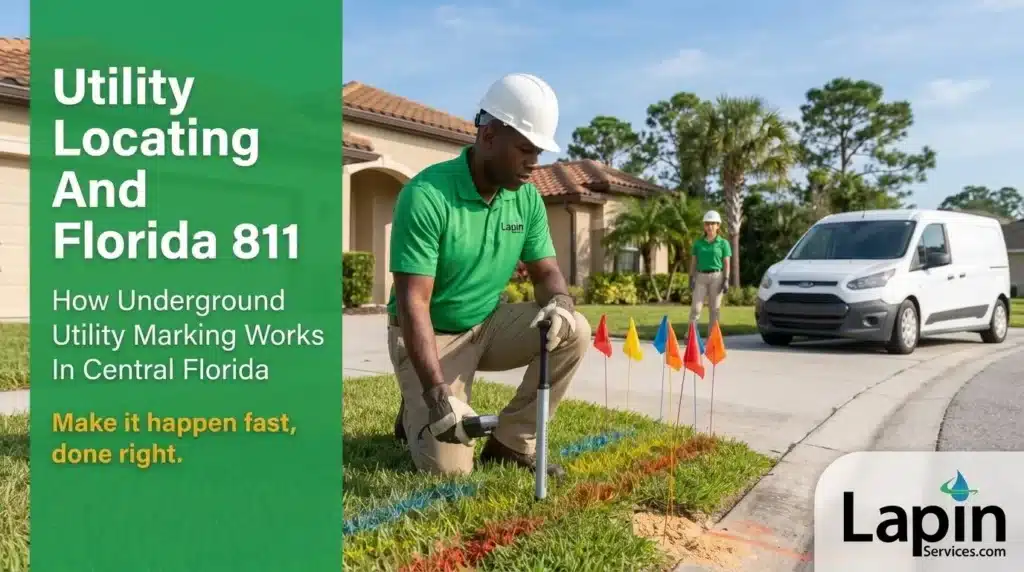
Flag and Paint Colors: The color code is standardized nationally. Red is electric, yellow is gas or petroleum, orange is communications, blue is potable water, green is sewer and drain, purple is reclaimed water or irrigation, pink is temporary survey markings and white is the proposed excavation area.
-
Where Lapin Fits: Lapin Services provides utility locating in Orlando and pairs it with in-house excavation and underground-utility crews, so the locate and the dig are handled by one company that has worked Central Florida soil since 1958.
A landscape crew in Conway is setting posts for a new fence along a side yard. The auger bites easily through the sand, then stops hard about two feet down. What it found was the cable and conduit run feeding the back half of the property, and nobody on site knew it was there because the property line looked like nothing but grass and a sprinkler head.
That is the ordinary version of a dig strike in Central Florida. It is rarely a dramatic scene. It is usually a small job, a shallow hole and a line nobody thought to check for, followed by an outage, a repair bill and a report. This article answers one question in full: how does 811 “”call before you dig”” work in Florida, and what does it cover and not cover before you break ground in Orlando.
The short version is that the 811 notification handles utility-owned lines in the public corridor and the service drops the utility is responsible for. Everything else buried on the property is yours to find, and that is where private locating and a contractor who also owns the excavation equipment become the difference between a clean job and a repair.
How does 811 “”call before you dig”” work in Florida?
Section Overview:
Florida 811, operated as Sunshine State One Call of Florida, is the statewide one-call notification center. You submit a locate ticket by phone at 811 or online, describing the dig site and work. Florida 811 relays it to member utility owners, who send locators to mark their buried facilities with paint and flags before your legal start date.
The process is a sequence, and each step exists to rule something out. Skipping a step is what turns a routine trench into an outage.
The ticket process, step by step
-
Define the Dig Area: Before you notify anyone, mark the proposed excavation area in white paint, white flags or white stakes. This is the white lining step, and it tells every locator exactly where to concentrate rather than guessing at a whole parcel.
-
Submit the Locate Ticket: Call 811 or file online with Florida 811. You provide the address, cross streets, the extent of the work area, the type of work and the equipment you will use. Accuracy here matters more than speed, because a vague description produces a vague locate.
-
Wait the Required Notice Period: Florida’s law requires advance notice before you begin, and the ticket carries a legal start date. Digging before that date removes your protection under the statute and puts the damage on you.
-
Locators Mark Their Facilities: Each member utility either marks its lines in the standard color code or responds that it has no facilities in the area. Positive response from every notified operator is what tells you the site is actually clear.
-
Verify Before the Bucket Drops: Walk the site and compare the marks to your ticket. If a utility you know serves the property has not responded or has not marked, do not start. Contact Florida 811 and get the ticket resolved first.
-
Dig Carefully Near the Marks: Locate marks show approximate horizontal position, not depth and not exact centerline. Inside the tolerance zone on either side of a mark, you switch to careful hand digging or vacuum excavation to expose the line before machine work continues.
What a ticket does not do
A locate ticket is a notification, not a permit and not a survey. It does not tell you how deep a line sits, and in sandy Central Florida soil, grade changes over the years mean a line that was installed at proper cover can end up shallower than anyone expects.
The ticket also expires. If the job stretches out, or if marks get mowed off, washed away by an afternoon storm or driven over, you request a re-mark rather than working from memory. Faded paint is not a locate.
What do the utility locate flag colors mean?
Section Overview:
Utility locate flags and paint follow a national color code so any crew can read any site. Red marks electric power lines and conduit. Yellow marks gas, oil and steam. Orange marks communications and fiber. Blue marks potable water. Green marks sewer and drain lines. Purple marks reclaimed water and irrigation. Pink marks temporary survey points. White marks the proposed excavation area.
Learning the colors takes a minute and saves a great deal. Below is the code as you will see it on an Orlando job site, with the practical meaning of each.
-
Red — Electric: Power lines, conduit, cable and lighting cables. Treat every red mark as energized. Strikes here carry the highest immediate risk to the person on the shovel.
-
Yellow — Gas, Oil and Steam: Natural gas and petroleum products. If you nick a yellow-marked line, you stop, clear people from the area, and call 911 and the gas utility from a safe distance. Never try to pinch, plug or bury a damaged gas line.
-
Orange — Communications: Telephone, cable television, fiber optic and alarm conduit. These rarely injure anyone, but fiber strikes shut down businesses and are among the costliest repairs on a residential street.
-
Blue — Potable Water: Drinking water mains and services. A broken main floods a work area quickly and can pull contamination into the distribution system, which is why utilities treat it seriously.
-
Green — Sewer and Drain: Sanitary sewer, storm drain and culverts. On many Central Florida properties, the green line and the septic system are the two things most likely to be in the path of a new patio or addition.
-
Purple — Reclaimed Water and Irrigation: Common across Orlando-area subdivisions where reuse water feeds neighborhood irrigation. Purple lines are easy to overlook because the pipe is usually shallow.
-
Pink — Temporary Survey Markings: Set by surveyors, not locators. Pink tells you where a boundary or control point sits, not where a utility runs.
-
White — Proposed Excavation: Your marks, placed before you file the ticket, showing the locators exactly where you intend to work.
When do you need private utility locating instead of 811?
Section Overview:
Private utility locating covers buried lines the utility company does not own, which 811 members will not mark. That includes septic tanks and drainfield laterals, irrigation mains, pool and spa feeds, landscape lighting conduit, sub-panel runs to detached garages, and any line past the meter. On commercial and HOA property, most of the underground network is privately owned.
This is the single most common gap in dig safety, and it is the reason people who did everything right still hit something. The 811 ticket was filed. The marks were honored. The strike happened anyway, on a line no member utility had any obligation to locate.
The causal chain behind a private-line strike
-
Ownership Boundary: The utility’s responsibility typically ends at the meter, pedestal or point of delivery. Past that point, the property owner owns the line.
-
No Record of Installation: Private lines often go in during a renovation, a pool build or a landscape project with no as-built drawing filed anywhere.
-
Turnover of Knowledge: The homeowner who watched the pool contractor trench the gas run sells the house. The HOA board that approved the irrigation loop rotates. The knowledge leaves with them.
-
Assumed Clearance: A crew sees no marks in the back yard and reads that as no lines. In reality it means nobody was asked to look.
-
The Strike: The bucket, auger or trencher finds the line first, and the discovery method is destructive rather than diagnostic.
Projects where a private locate belongs on the checklist
Any excavation past the meter deserves one. That includes septic tank replacement and drainfield work, water service replacement, sewer lateral repair, fence and post installation, tree planting and removal, pool decks, additions, generator pads and site lighting.
Commercial and multifamily sites raise the stakes because so much of the network is private. A shopping center’s grease line, fire loop, irrigation main and site lighting conduit are all owned by the property, not the utility. If you manage that kind of property, treat a private locate as part of scoping any sitework or new construction project rather than as an add-on.
How private locating actually works
A private locator uses electromagnetic locating equipment to trace conductive lines and tracer wire, and ground penetrating radar to find non-conductive pipe, tanks and voids where conditions allow. On sewer and drain lines, a locator can push a sonde through the pipe with a camera and trace it from the surface.
Central Florida conditions influence the method. Sandy soil, a high water table and clay lenses each affect what radar returns look like, which is why experience reading local ground matters as much as the equipment. Lapin Services provides professional utility locating in Orlando and pairs it with our own excavation and underground utility crews, so the same company that finds the line is the one that digs around it.
What happens if you hit a line, and how do you avoid it?
Section Overview:
If you strike a buried utility, stop work, protect people first and notify the utility owner. For a gas line, evacuate the area and call 911, then the gas company. Damage prevention comes from a valid Florida 811 ticket, private locating for lines past the meter, white lining, careful hand digging inside the tolerance zone and re-marks when paint fades.
Immediate response, in order
-
Stop and Assess: Shut down equipment and keep everyone clear. Do not attempt to move the machine off the line, and do not pull damaged conduit or pipe.
-
Evacuate for Gas: If you smell gas or hear escaping product, move upwind and away, eliminate ignition sources, and call 911 from a safe distance before you call anyone else.
-
Notify the Owner: Report the damage to the utility that owns the line, even if the damage looks minor. A nicked coating or scored conduit can fail later.
-
Document the Site: Photograph the marks, the excavation and the damage. Keep the ticket number. For commercial work this record supports your compliance documentation.
-
Resume Only After Clearance: Wait for the utility to make repairs and release the site before any further excavation in that area.
Prevention habits that hold up
The crews that go years without a strike are not lucky. They white line before they file, they verify positive response from every operator, they hand dig inside the tolerance zone, and they call for a re-mark instead of trusting three-week-old paint.
They also plan the locate into the schedule instead of treating it as a delay. The notification period is short compared to the outage that follows a strike, and it costs the excavator nothing. If your project involves both locating and digging, working with a single contractor and developer services partner removes the handoff where responsibility usually gets lost.
Real-World Scenarios
Winter Park Homeowner Setting Fence Posts Along a Side Yard
-
The Situation: A homeowner plans a six-foot privacy fence down both side yards. The auger will go deeper than any previous digging on the lot, and the fence line runs near the electric service and an old irrigation loop.
-
What 811 Covered: The ticket brought marks for the electric service drop, the water service and the communications line in the utility easement near the front corner.
-
The Private Line Gap: Nothing was marked in the back half of the yard, where a previous owner had run irrigation mains and low-voltage landscape lighting conduit with no records.
-
The Outcome: A private locate traced the irrigation and lighting runs, the post layout shifted by a few feet, and the fence went in without an outage or an irrigation repair.
Ocoee HOA Replacing a Section of Irrigation Main
-
The Situation: A community association needs to replace a failing section of reclaimed water main running behind a row of townhomes, with residents, mail kiosks and a common drive nearby.
-
What 811 Covered: Member utilities marked the gas main and the communications trunk in the corridor along the drive, plus the water services at the street.
-
The Private Line Gap: The reclaimed main itself, the site lighting conduit and several sanitary laterals crossing the work area were all association-owned and outside the 811 scope.
-
The Outcome: A private locate mapped the private network first, the trench was routed around two laterals, and the association received a marked plan useful for future property management projects.
Orlando Restaurant Extending a Grease Line to a New Interceptor
-
The Situation: A restaurant relocating its grease interceptor needs to trench across a parking lot to tie into the existing kitchen waste line, with the dining room staying open during the work.
-
What 811 Covered: The ticket produced marks for the gas service, the electric feed to the pad and the public sewer in the right-of-way at the lot entrance.
-
The Private Line Gap: The existing grease line, the fire loop, the site lighting circuits and the private sewer crossing the lot were all on the owner’s side of the meter and unmarked.
-
The Outcome: A private locate and a camera-and-sonde trace of the waste line set the tie-in point precisely, the trench avoided the fire loop, and the kitchen stayed operational. That kind of coordination is standard on business and facility projects.
Key Takeaways
-
811 Is the Starting Point: Filing a locate ticket with Florida 811 before you dig is required by Florida law, costs the excavator nothing and brings member utilities out to mark their facilities.
-
Coverage Stops at the Meter: 811 members mark only what they own. Septic components, irrigation, pool feeds, landscape lighting and sub-panel runs need private utility locating.
-
Colors Are Standardized: Red electric, yellow gas, orange communications, blue potable water, green sewer and drain, purple reclaimed and irrigation, pink survey, white proposed excavation.
-
Marks Are Approximate: Locate paint shows horizontal position, not depth or exact centerline. Hand dig inside the tolerance zone and request a re-mark when paint fades or the ticket expires.
-
One Crew Reduces Risk: Lapin Services performs utility locating in Orlando and runs its own excavation and underground-utility crews, keeping the locate and the dig under one responsible party.
Schedule Utility Locating and Underground Utility Work in Orlando
If you are planning an excavation anywhere in Central Florida, start with the Florida 811 ticket and then decide what private lines still need to be found. Lapin Services has been locating, digging and repairing underground utilities in Orlando since 1958, and our crews hold a BBB A+ rating and a 4.9-star reputation across more than 1,300 Google reviews.
Tell us what you are building and where, and we will scope the locate and the excavation together. Request a project quote or reach us any time at (407) 326-3367, including 24/7 emergency service if a line has already been struck.
External References
-
Florida Department of Environmental Protection: State-level guidance on water, wastewater and underground infrastructure programs in Florida. floridadep.gov
-
Occupational Safety and Health Administration: Federal standards and guidance for excavation and trenching safety on job sites. osha.gov
-
American Water Works Association: Technical resources on water distribution systems and buried infrastructure management. awwa.org
-
United States Environmental Protection Agency: Information on drinking water protection, sewer systems and decentralized wastewater. epa.gov
”