Fast Track Summary
- Root Cause Diagnostics: Persistent garbage disposal odors usually stem from decaying bio-sludge trapped beneath rubber splash guards, decomposing buildup in unpolished cast iron p-traps, or sewer gas escaping due to siphoned or unvented island sink lines.
- Environmental & Structural Risks: Central Florida’s high humidity and intense heat accelerate bacterial gas generation within kitchen drainage lines, turning minor organic remnants into potent hydrogen sulfide gas that migrates into living spaces.
- Advanced Mechanical Solutions: Simple household hacks fail when drainage geometry is compromised; resolving recurring foul smells requires mechanical removal of organic matrices, proper p-trap self-sealing, and compliant secondary venting.
- Professional Engineering Intervention: Lapin Services leverages video pipe inspection, targeted mechanical hydro-clearing, and complete drain line re-venting to permanently eliminate drain odors and protect indoor air quality.
Why Is Bad Smell Coming From Your Garbage Disposal Even After Cleaning?
A routine kitchen cleanup turns baffling when a sharp, decaying sewage odor continues to emanate from the kitchen sink despite scrubbed basins, citrus peels, and store-bought drain cleaners. In multi-family communities, commercial kitchens, and residential properties across Orlando and Central Florida, persistent garbage disposal sewer smell is rarely a superficial cleanliness issue. Instead, it signals hidden organic decomposition, compromised plumbing mechanics, or negative pressure pulling raw sewer gas directly into the structure.
When standard maintenance fails to clear drain odors, the culprit lies within the hidden geometry of the disposal unit, the p-trap, or the building’s broader drain-waste-vent network.
Section Overview: Persistent garbage disposal sewer smell is caused by organic bio-sludge accumulation under splash guards, stagnant waste trapped in improperly pitched lines, dried or siphoned P-traps, or missing DWV pipe venting. In Central Florida, warm ambient temperatures accelerate volatile sulfur compound production, requiring mechanical clearing, line re-pitching, or proper venting solutions rather than temporary topical chemical flushes.
Primary Locations of Persistent Disposal Odors
To systematically diagnose recurring smells, plumbing specialists isolate five primary structural zones within the sink assembly:
- Underside of the Rubber Splash Guard: Collects decomposing food particles, starches, and FOG sludge that top-down rinsing never reaches.
- Lower Impeller Plate and Grinding Chamber Crevices: Houses micro-crevices where organic matter binds with mineral deposits to form an anaerobic bio-film.
- Unpitched Drain Arms and Corrugated Flex Extensions: Features internal ridges and stagnant low points that collect decaying waste over time.
- Dry, Siphoned, or Evaporated P-Traps: Loses the essential standing water barrier, allowing volatile sewer gases to vent directly into the kitchen.
- Unvented Island Sink Branch Lines: Suffers from mechanical failure in Air Admittance Valves (AAVs), allowing negative pressure to draw sewer gas past the trap.
Hidden Mechanisms Behind Trapped Food Particle Odors and Gas Migration
A persistent garbage disposal sewer smell occurs when organic matter degrades in anoxic zones inside the grinding chamber or when the liquid seal inside the P-trap breaks, allowing volatile organic compounds and hydrogen sulfide gas from the drainage branch to escape upward into the kitchen.
Path of Organic Waste and Gas Migration
Understanding how gas moves through a drainage assembly requires tracing the fluid and atmospheric route from the sink basin to the municipal line:
- The Sink Basin Collar: Water and waste enter through the top flange, passing through the flexible rubber splash guard.
- The Upper Splash Guard Lip: Traps rising grease and fine organic particulate matter along its flexible underside ribs.
- The Grinding Chamber Housing: Houses rotating impellers and a stationary shredder ring where micro-crevices accumulate organic biomats.
- The Disposal Drain Outlet: Channels pulverized waste into the discharge elbow, where improper pitch can lead to sediment settlement.
- The P-Trap Water Seal: Maintains a continuous liquid barrier that prevents volatile sewer gases from rising back up the line.
- The Downstream Sewer Lateral: Conveys wastewater to the septic tank or municipal main, where sewer gas originates.
Standard cleaning methods address only the visible stainless steel sink basin. They miss the complex spatial dynamics of the disposal’s lower housing, discharge elbow, and downstream branch piping.
- Splash Guard Bio-Film Accumulation: The undersides of flexible rubber splash guards feature reinforced structural ribs that collect grease, particulate food waste, and starch. This material decomposes rapidly out of reach of top-down rinsing.
- Crevice Bio-Sludge Formation: Fine organic debris mixes with fats, oils, and grease (FOG) beneath the rotating impeller plate, forming an anaerobic biomat layer that continuously releases volatile organic compounds.
- Hydraulic Trap Evaporation and Siphoning: Rapid water flow from high-GPM fixtures or unvented discharge lines can siphon water out of the P-trap, removing the mechanical liquid barrier that isolates indoor space from the municipal sewer or septic system.
- Corrugated Extension Pipe Traps: Flexible, accordion-style drain pipes create internal ridges that collect decaying matter, restricting flow velocity and creating chronic odor reservoirs.
- Failing Air Admittance Valves (AAVs): Mechanical vents installed beneath kitchen island sinks can experience diaphragm failure, sticking open and allowing sewer gas to pull back into the cabinet cavity and sink area.
Mechanical Accumulation Points Inside Disposal Housings
The internal construction of continuous-feed and batch-feed disposals relies on centrifugal force to push waste through a stationary shredder ring. Small particles of stringy vegetables, animal fats, and calcified starch bypass the impellers and settle into the lower housing seal.
Over time, this material forms a dark, gelatinous sludge. Running cold water flushes loose material through the unit, but it does not dislodge the adhering bio-film clinging to the upper non-rotational surfaces of the housing. When the unit is idle, ambient indoor heat warms this mass, accelerating microbial activity and producing noticeable sewer-like gases.
When home troubleshooting methods do not clear the issue, professional evaluation of your home or commercial building’s system is essential. Homeowners and facility operators can check our comprehensive sewer and drain services to evaluate line integrity and downstream trap hydraulics.
Florida Environmental Factors Accelerating Drain Decomposition
Central Florida’s environmental conditions exacerbate kitchen drainage issues. High ambient temperatures, elevated humidity, and flat terrain influence household and commercial plumbing dynamics.
- High Ambient Heat and Humidity: Accelerates bacterial metabolic cycles and volatile hydrogen sulfide gas production within static drain lines.
- Elevated Regional Water Tables: Reduces natural drainfield gravity head, increasing structural line surcharging and backpressure.
- Flat Low-Slope Grade Piping: Decreases hydraulic scour velocity along horizontal branches, allowing sediment and FOG sludge to settle out of suspension.
- Heavy Seasonal Downpours: Saturates upper soil layers, exerting pressure on plumbing vent stacks and inducing trap siphonage in low-lying fixtures.
In cities like Orlando, Winter Park, and Kissimmee, shallow groundwater tables demand precise slope calculations for sanitary lateral lines. When heavy summer downpours saturate the soil, structural drain lines experience minor hydro-static backpressure variations.
If a building’s plumbing stack lacks proper atmospheric pressure equalization, these pressure shifts can force sewer gas through small cracks in P-trap seals. Florida’s heat also speeds up bacterial metabolic cycles within static drain lines. This accelerates the transformation of trapped fats and proteins into sulfur dioxide and hydrogen sulfide gases.
Property owners facing recurring sewer gas problems or drainage backups after heavy rain should inspect their external infrastructure. Reviewing our guide on septic system problems can help determine if the smell stems from an isolated sink line or a surcharged drainfield.
Architectural Venting Mechanics and Island Sink Drainage Challenges
A persistent garbage disposal sewer smell is frequently caused by poor atmospheric pressure balance in the drain line rather than trapped food waste alone. Kitchen island sinks, modern open-concept layouts, and renovated commercial breakrooms often lack direct vertical vent stacks through the roofline.
Section Overview: Island sink branch lines rely on Air Admittance Valves (AAVs) or Chicago-loop island venting schemes to maintain neutral pressure. Mechanical failure of an AAV or a blocked atmospheric vent causes negative pressure during disposal discharge, siphoning the P-trap dry and pulling raw sewer gas directly into the building through the disposal basin.
Conventional Roof Venting vs. Island Air Admittance Valves
To understand pressure management in island sink applications, compare the operational mechanics of traditional vertical venting with mechanical air admittance valves:
- Conventional Roof Vent Systems: Use a continuous, open-air vertical pipe extending directly through the roof structure. This design provides unimpeded atmospheric pressure equalization using natural air movement, eliminating the risk of mechanical valve failure.
- Island Air Admittance Valve (AAV) Systems: Use a mechanical, spring-loaded or gravity-seated diaphragm installed inside the cabinet under the sink. The valve opens under negative pressure to admit ambient room air into the drain pipe during discharge, then seals shut under neutral pressure to block sewer gas. Over time, grease vapors and mechanical wear can cause the diaphragm to stick open, venting gas into the cabinet, or stick closed, causing trap siphoning.
Without a dedicated atmospheric vent pipe rising through the roof, plumbing systems must use secondary venting methods to preserve the P-trap’s water barrier.
- Air Admittance Valve Diaphragm Degradation: An AAV features a flexible rubber membrane that opens under negative pressure to admit room air into the drain pipe, then seals shut under neutral pressure. FOG vapors, age, and chemical degradation can cause this seal to stick open, continuously venting sewer gas into the sink cabinet.
- Loop Vent Siphonage: Traditional island loop vents rely on a secondary relief leg. If this relief leg accumulates scale, grease, or debris, it loses its pressure-equalizing capacity, causing the P-trap water to siphon out when the disposal empties.
- Induced Hydraulic Siphonage: When a garbage disposal runs, its internal impeller acts as a low-pressure pump, discharging water down the pipe at a higher rate than gravity drainage. This rapid discharge can pull air through the trap, siphoning out the protective water barrier if the branch line lacks adequate venting.
- Cross-Connection Trapping: Dual-compartment sinks improperly piped with a continuous waste line lacking a baffle tee allow high-velocity disposal discharge to cross over into the adjacent sink basin’s P-trap, displacing its water seal and forcing air out through the sink drain.
Diagnosing P-Trap Seal Loss vs. Surface Decomposition
Distinguishing between trapped organic matter and raw sewer gas entering through a dry trap requires targeted diagnostic testing:
- Surface Isolation Cover Test: Cover the disposal drain opening with an airtight rubber plug for four hours. If the odor dissipates in the kitchen but remains concentrated directly under the plug upon removal, the source is localized upper housing decomposition or splash guard bio-sludge.
- P-Trap Water Level Visual Check: Shine a bright flashlight down the disposal drain immediately after running the unit. If the visible standing water level rests below the internal dip of the P-trap bend, the system is suffering from induced siphoning or evaporation.
- Cabinet Air Quality Assessment: Open the cabinet doors underneath the sink basin and evaluate the air quality. If the foul odor is noticeably stronger inside the cabinet cavity than inside the sink basin, the Air Admittance Valve has failed or a slip-joint connection is leaking sewer gas.
- Downstream Static Pressure Test: Run adjacent high-volume fixtures, such as a dishwasher or nearby washing machine. If the kitchen sink drain gurgles or emits a burst of foul air during discharge, the system has a downstream branch restriction or a blocked roof vent stack.
When a property experiences widespread drainage issues across multiple fixtures, the problem likely extends beyond an isolated sink line. Property managers facing complex multi-fixture odors can consult our guidance on drains backed upto locate main-line blockages or branch stack restrictions.
Technical Solutions and Step-by-Step Restoration Protocols
Eliminating a persistent garbage disposal sewer smell requires systematic, mechanically sound intervention. Topical remedies like pouring baking soda, vinegar, or harsh corrosive chemicals into the basin offer only temporary masking effects. In fact, strong chemical drain cleaners can harden bio-sludge mats, degrade rubber gaskets, and corrode cast iron piping.
Systematic Mechanical Odor Removal Sequence
- Electrical Isolation and Lockout: Disconnect the electrical supply at the main breaker or unplug the unit under the sink to ensure safety before performing manual cleaning.
- Manual Splash Guard Decontamination: Remove and scrub the flexible rubber splash guard using an abrasive brush and an oxygenated degreasing agent.
- Mechanical Grinding Chamber Scouring: Deploy abrasive media into the grinding chamber to clean internal impellers and housing walls through friction.
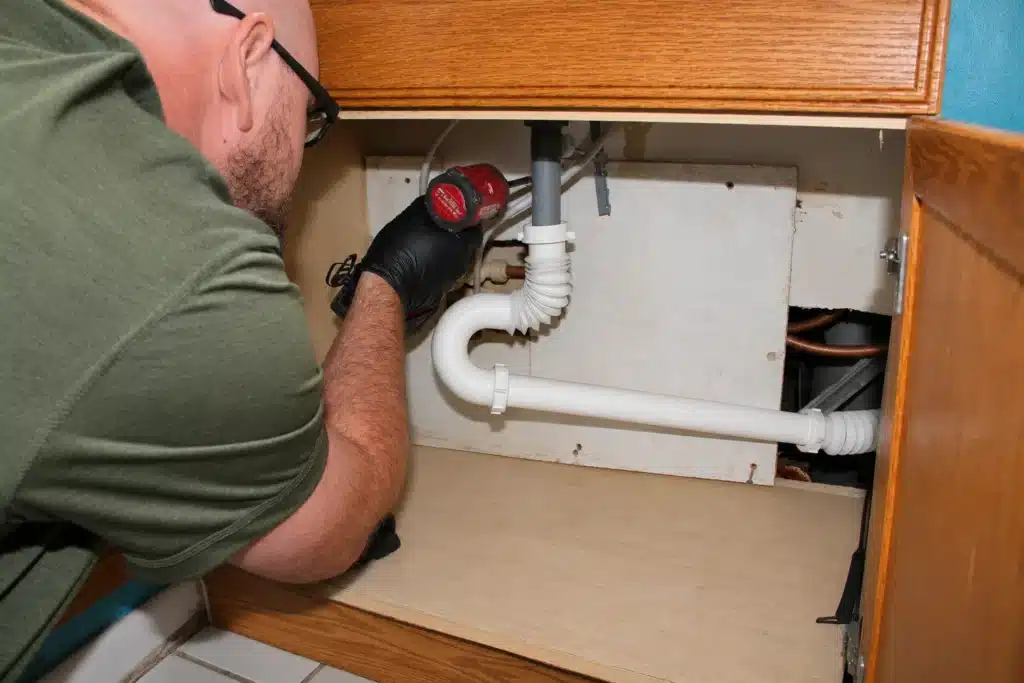
- P-Trap Disassembly and Inspection: Remove slip-joint assemblies to manually clear bio-sludge from horizontal wall arms and inspect the standing water depth.
- Air Admittance Valve Pressure Verification: Test and replace aging mechanical vents to ensure airtight performance under neutral static pressure.
- High-Volume Hydraulic Flushing: Flush the branch line with warm water to verify free-flowing discharge and proper trap seal restoration.
Step 1: Electrical Isolation and Splash Guard Restoration
Always disconnect electrical power at the main breaker panel or unplug the unit beneath the sink before performing manual maintenance inside or around a garbage disposal.
- Remove and Clean the Rubber Splash Guard: If the unit features a removable splash guard, pull it out from the sink collar. Scrub its underside thoroughly using an abrasive brush and an oxygenated degreaser to remove clung FOG sludge.
- Scrub the Upper Collar: For non-removable splash guards, pull the rubber baffles upward. Use a stiff, flexible tube brush to clean the recess where the stainless steel sink flange connects to the upper disposal housing.
- Clean the Housing Crevices: Inspect the upper rim of the grinding chamber with a flashlight. Manually remove trapped grease, stringy vegetable fibers, and bio-film build-up using long-handled mechanical scrapers.
Step 2: Mechanical Scouring of the Grinding Chamber
Once the upper housing is free of debris, clean the internal impeller mechanism and shredder ring mechanically without using corrosive chemicals.
1
Load Abrasive Media
Do not use solid metal objects or chemical drain openers
Fill the disposal chamber with two cups of solid ice cubes and one cup of coarse rock salt. The ice acts as a high-velocity abrasive medium against the shredder ring, while the rock salt scours the lower housing walls.
2
Initiate Mechanical Scour Cycle
Turn on the cold water line at medium flow and engage the electrical power to the disposal unit. Allow the impellers to grind the ice completely, driving the salt granules into micro-crevices along the grinding plate.
3
Flush with Neutralizing Solution
Follow the mechanical scour immediately with a high-volume flush of warm water mixed with liquid castile soap to emulsify liberated organic fats and wash them down the branch line.
Step 3: P-Trap Inspection and Branch Cleansing
If the odor persists after cleaning the disposal housing, inspect the downstream drainage assemblies beneath the sink.
1
Disassemble P-Trap Assembly
Place a bucket beneath the P-trap and loosen the slip nuts manually or with channel locks. Remove the P-trap bend and wall arm completely.
2
Inspect for Sludge Accumulation
Examine the internal horizontal wall arm for bio-sludge or calcified deposits. Scrub the interior surfaces using a flexible wire bottle brush to restore the pipe’s original interior diameter.
3
Verify Trap Seal Pitch
Reinstall the P-trap assembly, ensuring a vertical trap seal depth between two and four inches. Verify that the sanitary wall arm pitches downward toward the wall stack at a minimum slope of 1/4 inch per linear foot according to Florida Building Code requirements.
4
Replace Air Admittance Valves
If the sink uses an AAV, unscrew the existing valve from the vertical branch riser. Replace it with a properly rated valve, sealing the threads with PTFE tape to ensure an airtight mechanical connection.
If you discover corroded cast iron, damaged PVC joints, or persistent slow drainage during trap disassembly, explore our residential and commercial plumbing solutions to restore proper flow and structural integrity.
Commercial Facilities, Multi-Family Infrastructure, and Municipal Compliance
Commercial kitchens, restaurant facilities, multi-family housing complexes, and food service venues face unique challenges with disposal odors and drain line maintenance. High volumes of fats, oils, and grease (FOG), combined with continuous kitchen operations, subject drainage branch networks to rapid bio-sludge buildup.
Operational Comparison: Commercial vs. Residential Drainage Systems
To maintain system health across varying building footprints, property managers must understand how commercial demands differ from standard home use:
- Flow Volume and FOG Loading: Residential systems experience intermittent low-volume flows with low fat concentrations. Commercial and multi-family kitchens handle continuous high-volume discharge with heavy grease loading that builds thick bio-sludge deposits.
- Regulatory Compliance Standards: Residential plumbing is governed by basic local plumbing codes. Commercial facilities must comply with strict FDEP regulations, Florida Department of Health codes, and municipal Orange and Seminole County FOG ordinances.
- Venting Infrastructure: Home systems utilize direct vertical roof vents or single AAV units. Commercial layouts require high-capacity AAVs, engineered manifold vents, or combined loop venting schemes to handle multi-fixture discharge.
- Preventative Maintenance Protocols: Residential care relies on quarterly DIY scouring and basic trap checks. Commercial operations require scheduled hydro-jetting, grease interceptor pumping, and certified inspection logging.
In commercial and municipal applications, resolving persistent drainage odors involves strict adherence to environmental regulations and local municipal wastewater discharge standards.
According to regulatory frameworks maintained by the Florida Department of Environmental Protection (FDEP) and local county utilities (such as Orange County Environmental Protection Division and Seminole County Environmental Services), commercial facilities must prevent FOG accumulation from reaching municipal main force mains or onsite lift stations.
- FOG Compliance and Grease Interceptors: Commercial food service disposals often discharge into dedicated grease interceptors. If a grease interceptor becomes full or develops broken baffles, high-pressure grease gas can back up through branch lines, venting out through disposal units in kitchen work areas.
- Hydro-Jetting PSI and GPM Tolerances: Clearing grease accumulation in commercial drain lines requires precise mechanical hydro-jetting. Water pressure must be carefully calibrated—typically between 1,500 and 3,000 PSI at 4 to 8 GPM—to scrub interior pipe walls clean without damaging older clay, PVC, or cast iron pipes.
- Commercial Lift Station Integrity: Large commercial properties rely on lift stations to pump wastewater to municipal mains. When lift station floats fail or transducers misread liquid levels, sewage sits in wet wells longer, accelerating anaerobic digestion and forcing volatile gases back into building branch lines.
- Preventative Maintenance Logs: Commercial properties are often required by local ordinances to maintain detailed service records for grease trap pumping, line jetting, and plumbing inspections to avoid municipal fines or forced shutdowns.
Commercial kitchen operators and facility directors seeking to maintain regulatory compliance and prevent emergency backups can examine our specialized commercial grease trap services in Orlando for comprehensive operational support.
Furthermore, multi-family property managers and industrial site supervisors who manage low-lying drainage or pump systems can review our commercial lift station services in Orlando to ensure proper wet-well operation and pressure balance.
Technical Case Studies: Resolving Complex Odor Diagnostics
The following field scenarios demonstrate how Lapin Services diagnoses and resolves challenging sewer gas issues across Central Florida residential, commercial, and civil infrastructure projects.
Case Scenario 1: Unvented Island Sink Siphonage in Winter Park Residence
- Property Context: A high-end residential kitchen renovation in Winter Park, FL, featured an island sink with a high-horsepower garbage disposal.
- Diagnostic Finding: The homeowner reported a severe sewer gas odor that appeared only after running the disposal. A high-resolution sewer camera inspection revealed that the contractor had omitted an Air Admittance Valve, connecting the disposal directly to an unvented 2-inch drain arm.
- Mechanical Solution: The rapid discharge from the high-horsepower motor created a vacuum that siphoned the P-trap dry after every use, exposing the home to raw sewer gas. Lapin Services re-engineered the under-sink assembly, installing a dual-pipe sanitary branch fitted with a high-capacity AAV at the maximum allowable height under the cabinet. This permanently stabilized system pressure and eliminated the odor.
Case Scenario 2: Commercial Kitchen FOG Backpressure in Orlando Restaurant
- Property Context: A busy commercial kitchen in downtown Orlando experienced recurring sewer gas smells coming from its dishwashing and food preparation sinks during peak meal services.
- Diagnostic Finding: Diagnostic field testing revealed that the restaurant’s outdoor grease interceptor had exceeded its 25% FOG storage capacity, causing grease-laden sludge to back up into the main horizontal discharge branch.
- Mechanical Solution: The buildup restricted air movement, forcing gases generated in the interceptor back through the unsealed kitchen disposals. Lapin Services performed a complete grease interceptor pump-out, followed by targeted mechanical hydro-jetting at 2,200 PSI to clear grease scale from the lateral lines. A customized preventative maintenance schedule was established to keep the business fully compliant with local municipal FOG ordinances.
When to Call Master Plumbing and Underground Utility Specialists
When standard maintenance, mechanical cleaning, and trap inspections fail to resolve a persistent garbage disposal sewer smell, the issue often resides deeper within the drainage line, main sewer lateral, or external utility infrastructure.
Escalation Matrix for Professional Intervention
- Multi-Fixture Gurgling or Sewer Odors: Indicates a central main sewer line blockage, collapsed lateral pipe, or extensive tree root intrusion.
- Recurring Dry P-Trap Despite Valve Replacement: Points to a damaged main vent stack, broken roof flashing, or severe sewer line pressure imbalance.
- Persistent Sewage Odor Inside Cabinets and Walls: Signals a surcharged lift station wet well, float switch electrical failure, or cracked drain line behind the sheetrock.
- Slow Drainage Combined with Foul Gas Emissions: Indicates a structural sag (pipe belly) along the underground lateral or a failing septic absorption drainfield.
Attempting repeated DIY chemical clearing on persistent odors can damage plumbing infrastructure, erode pipe walls, and mask serious mechanical defects.
Lapin Services brings comprehensive master-level expertise to every project. As a fully triple-licensed contractor holding certifications as a Master Septic Contractor (SM0890812), Certified Plumbing Contractor (CFC1428594), and Underground Utility Contractor (CUC1223686), our team diagnoses and resolves complex plumbing and drainage challenges across Central Florida.
The Lapin Services Triple-License Engineering Advantage
Our triple-licensure ensures complete regulatory compliance and seamless field execution across residential, commercial, and civil sitework applications:
- Master Septic Contractor (License # SM0890812): Authorizes advanced onsite sewage treatment system (OSTDS) engineering, aerobic treatment unit (ATU) maintenance, drainfield soil loading calculations, and high-water-table mitigation.
- Certified Plumbing Contractor (License # CFC1428594): Covers complex interior building drain-waste-vent (DWV) piping, commercial grease interceptor sizing, multi-story hydraulic balancing, and precision backflow prevention.
- Underground Utility Contractor (License # CUC1223686): Permits deep-excavation sewer lateral installations, municipal force main connections, commercial lift station wet well construction, and roadway utility tap-ins.
Whether you need advanced inline video camera inspections, mechanical hydro-jetting, lift station servicing, or complete underground main line replacement, our field technicians deliver precise, long-lasting results.
Property owners and facility managers can submit a request through our request a project quote page to schedule a comprehensive diagnostic evaluation with our engineering team.
External References
To learn more about plumbing standards, environmental regulations, and wastewater guidelines, consult these industry resources:
- Florida Department of Environmental Protection (FDEP) – Onsite Sewage Programs
- U.S. Environmental Protection Agency (EPA) – SepticSmart Program Guidelines
- American Society of Plumbing Engineers (ASPE) – Plumbing Design Standards
Key Takeaways
- Target Underside Surfaces: Garbage disposal odors usually originate from organic bio-sludge trapped beneath the flexible rubber splash guard and in the upper housing collar, surfaces that standard basin water flows do not reach.
- Verify P-Trap Hydraulic Integrity: A dry or siphoned P-trap loses its water seal, creating an open path for raw sewer gas to enter living and working spaces through the sink drain.
- Inspect Island Venting Mechanicals: Sinks located in kitchen islands require functional Air Admittance Valves (AAVs) or engineered loop vents to equalize pressure and prevent trap siphoning during high-velocity disposal discharge.
- Avoid Corrosive Chemical Openers: Chemical drain cleaners can harden bio-sludge layers, damage rubber disposal components, and corrode cast iron lines without addressing the mechanical cause of the odor.
- Address Commercial FOG Accumulation: Commercial kitchens must maintain grease interceptors and perform scheduled hydro-jetting to prevent FOG backups, sewer gas venting, and municipal compliance violations.
- Leverage Triple-Licensed Specialists: Persistent drain odors accompanied by multi-fixture gurgling or slow drainage require professional video pipe inspection and diagnostic evaluations from licensed plumbing and underground utility contractors.
If a persistent garbage disposal sewer smell, slow drainage line, or unexpected plumbing backup is affecting your home, multi-family property, or commercial facility, do not let sewer gas compromise your indoor air quality or mechanical systems. The experienced team at Lapin Services is ready to assist with comprehensive diagnostic inspections, high-precision hydro-jetting, and complete drain-waste-vent repairs across Orlando and Central Florida. Contact our team today through our 24/7 emergency services hub or submit an online request for an on-site evaluation to permanently restore your plumbing infrastructure.