Clearing a Violation and Documenting the Pump-Out
- Immediate Containment: A failed inspection requires instant mitigation—stop dumping FOG into the line, clear grease interceptor baffles, and schedule certified pumping.
- Manifest Compliance: Municipalities demand complete FDEP-aligned waste disposal manifests proving 100% pump-outs and legitimate recycling site delivery.
- Hydro-Jet Remediation: Surface pumping alone fails code; high-pressure hydro-jetting is required to scour hardened fat accumulation from lateral lines.
- Regulatory Alignment: Partnering with a triple-licensed contractor ensures emergency pumping, line restoration, and rapid reinspection documentation within 24 hours.
Emergency Grease Trap Remediation: How to Clear Health Department Violations in 24 Hours
When an inspector from the Orange County Environmental Protection Division, the City of Orlando, or the Florida Department of Health walks into your commercial kitchen unannounced, they are evaluating your operational compliance against strict environmental standards. A failed grease trap inspection triggers an immediate countdown, placing your establishment at risk of heavy municipal fines, mandatory operational shutdowns, or stop-work orders on dishwashing stations. To clear a health department violation within 24 hours, facility directors must immediately cease discharging grease into lines, execute a complete 100% interceptor pump-out, mechanically scour all internal baffles, and obtain a Florida Department of Environmental Protection (FDEP) compliant waste tracking manifest for inspector review.
Understanding the precise mechanical and hydraulic reasons why a grease interceptor fails an inspection is essential for immediate remediation and long-term compliance. Inspections rarely fail simply because an interceptor has collected a small amount of waste. Instead, failure occurs when the internal volume breaches statutory environmental limits, leading to hydraulic bypass and structural non-compliance.
The Mechanics of Interceptor Separation and Hydraulic Failure
A commercial grease interceptor relies on physical gravity separation, hydraulic detention time, and temperature differentials to remove Fats, Oils, and Grease (FOG) from kitchen wastewater before it enters municipal sewer mains.
- Influent Wastewater Entry: High-temperature wastewater containing dissolved fats, food solids, and detergent enters the primary chamber of the interceptor directly from pot sinks, dishwashers, and floor drains.
- Thermal Cooling and Flotation: As wastewater enters the larger volume of the interceptor, flow velocity drops dramatically. The liquid cools, causing low-density fats and oils to separate from water and float to the surface, creating an upper FOG layer.
- Solids Sedimentation: Heavier organic food particles and soil settle to the floor of the interceptor chamber, forming a dense sludge layer at the bottom.
- Clarified Effluent Discharge: Mid-depth wastewater, now isolated from both the floating FOG layer and the settled bottom sludge, passes under an internal baffle wall and discharges into the municipal sewer system.
The Critical 25% Rule and Why Interceptors Fail
Municipal wastewater ordinances across Orange, Seminole, and Osceola counties strictly enforce the 25% Rulederived from EPA pretreatment guidelines. An interceptor is classified as mechanically failed when the combined thickness of the top floating FOG layer and the bottom settled sludge layer exceeds 25% of the total liquid depth inside the tank.
- Loss of Detention Time: When the combined waste layer exceeds 25%, the effective liquid volume inside the tank shrinks. High-velocity kitchen discharge rushes through the reduced space without staying long enough to cool or separate.
- Grease Bypass: Short-circuited wastewater carries suspended fats directly past the outlet baffle wall into the municipal sewer line, causing severe pipe blockages downstream.
- Baffle Clogging and Structural Damage: Accumulating grease cakes around structural inlet and outlet baffles, restricting flow, causing kitchen floor drain backups, and generating dangerous hydrogen sulfide gases.
Four-Step Protocol for 24-Hour Inspection Clearance
When faced with an emergency non-compliance citation or a 24-hour corrective order, restaurant operators must execute a systematic mechanical response rather than relying on temporary measures.
- Halt Heavy Water Discharges: Immediately isolate high-volume dishwashing lines and commercial kettle drains to stop pushing unseparated wastewater into the compromised interceptor.
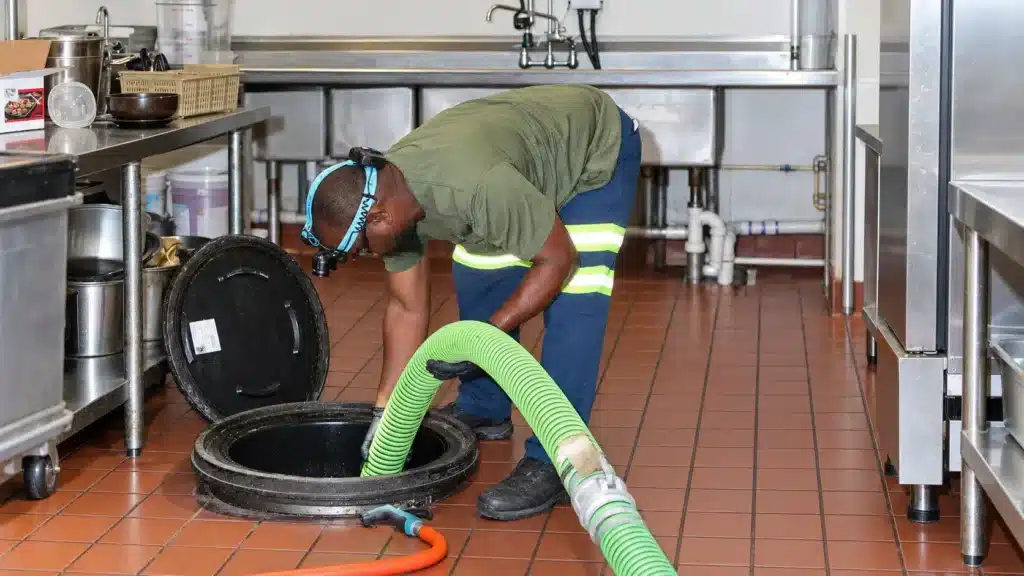
- Execute a 100% Interceptor Pump-Out: Reject partial surface skimming. Require your service contractor to pump the interceptor completely empty, removing all liquid, floating FOG, and compacted bottom sludge down to the bare concrete or fiberglass floor.
- Scour Baffles and Pressure Wash Interior Walls: Instruct field technicians to scrape baffle walls, inspect tees for structural cracking, and pressure-wash internal sidewalls to eliminate residual grease deposits that degrade new wastewater.
- Secure Fully Executed FDEP Waste Manifests: Obtain an official state waste tracking manifest signed by a certified liquid waste transporter. This document must record the exact gallonage pumped, date of service, vehicle certification, and the state-approved disposal or recycling facility receiving the waste.
The Hidden Risks of Chemical and Biological Additives
Kitchen managers facing a failed inspection often attempt a quick fix by pouring chemical emulsifiers, enzymes, or biological additives down kitchen drains. Environmental enforcement agencies explicitly prohibit these products under municipal sewer use ordinances.
- Temporary Emulsification: Enzymes and chemical detergents do not destroy grease; they temporarily break FOG into microscopic droplets that pass through the interceptor.
- Downstream Re-solidification: Once the chemical agent dilutes further down the sewer main, the emulsified fats separate and re-solidify into massive grease blockages inside municipal infrastructure.
- Severe Environmental Fines: Municipalities routinely sample sewer lateral discharge. Detecting illegal chemical dosing can result in severe fines, revocation of sewer discharge permits, and immediate facility closure.
Partnering with a dedicated provider like Lapin Services ensures access to certified emergency response teams equipped to handle complete tank pumping, structural repairs, and fast-track compliance reporting.
How High Water Tables and Line Scaling Cause Structural Interceptor Failures
Underground grease interceptors in Central Florida operate in complex hydrogeological environments characterized by high water tables, coastal sandy soils, and extreme seasonal rainfall. Groundwater infiltration through unsealed manhole risers, cracked tank walls, or worn pipe gaskets reduces available hydraulic capacity, causing grease to bypass the tank and triggering unexpected health inspection failures. Resolving these deep structural issues requires advanced high-pressure hydro-jetting, fiber-optic video diagnostics, and specialized civil site remediation to stabilize underground utility infrastructure and ensure long-term environmental compliance.
Environmental Stressors on Central Florida Interceptor Infrastructure
Underground concrete and fiberglass interceptors in regions like Orlando, Kissimmee, and Winter Park face intense environmental pressures that impact mechanical performance:
- Hydrostatic Pressure and Groundwater Infiltration: Central Florida’s high water table places continuous external pressure on buried tanks. Water enters through microscopic wall fissures or compromised joint seals, filling tank capacity with clean groundwater and displacing wastewater before proper separation occurs.
- Hydrostatic Buoyancy and Tank Flotation: Emptying a buried interceptor located in water-saturated sandy soil creates tremendous upward buoyant force. Inexperienced pumping contractors who completely empty a tank without assessing surrounding soil saturation risk floating or shifting the structure, which can sever inlet and outlet pipe connections.
- Acidic Wastewater Degradation: Biological decomposition of organic food waste inside a grease interceptor generates sulfuric acid. Over time, acidic sewer gas corrodes unlined concrete walls, erodes mortar joints, and eats away metal baffle brackets, creating leak paths into the surrounding water table.
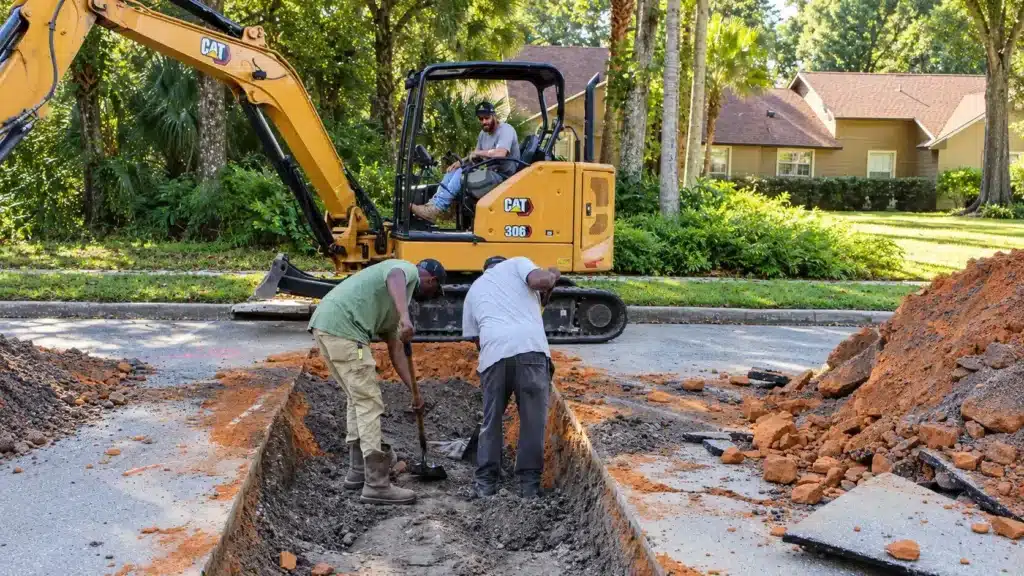
When underground structural failures compromise utility connections, facility owners must consult a qualified underground utility installation specialist to repair damaged lateral pipes, seal tank structures, and restore hydrogeological stability.
The Physics of Pipe Scaling and Hydro-Jetting Remediation
Fats, oils, and grease discharged into drainage lines undergo saponification—a chemical reaction where fats combine with alkaline minerals in wastewater to form solid, soap-like deposits along pipe walls. Standard mechanical drain snakes merely punch narrow holes through these calcified deposits, leaving the majority of the restriction intact and leading to repeated line backups.
Fully restoring sewer pipe diameter requires high-pressure hydro-jetting, which balances water volume (Gallons Per Minute / GPM) and water pressure (Pounds Per Square Inch / PSI) based on pipe material and structural condition:
- PVC and ABS Lateral Lines: Technicians apply water pressures between 2,000 and 3,000 PSI at 12 to 15 GPM. This combination creates a scouring action that washes away sticky FOG buildup and soft food solids without stressing glued plastic joints.
- Cast Iron and Clay Mains: Older cast iron and vitrified clay pipes require specialized rotating backward-facing nozzles operating at 3,500 to 4,000 PSI with 18 GPM. The high-velocity streams shear off mineralized grease scale and intrusive root masses without fracturing brittle pipe walls.
- Fiber-Optic Video Verification: Following hydro-jetting, technicians deploy self-leveling HD sewer cameras through the lines. This visual inspection confirms complete pipe cleaning, identifies structural cracks or sags, and produces video evidence for municipal health inspectors.
Plumbing and facility managers requiring comprehensive line cleaning and diagnostic reporting can rely on specialized hydro-jetting services to clear deep line blockages and prevent recurring inspection citations.
Downstream Wastewater Lift Station Vulnerabilities
When an underground grease interceptor fails mechanically, unseparated grease passes directly into downstream infrastructure, creating severe risks for properties reliant on private sewage lift stations.
- Grease Coating on Float Switches: Floating fat enters the wet well and coats mechanical float switches. Weighted down by heavy grease layer crusts, the floats cannot tilt properly, preventing automatic pump activation and leading to massive commercial sewage overflows.
- Submersible Pump Impeller Clogging: Compacted grease and fibrous debris wrap around submersible pump impellers, restricting water flow, triggering thermal overload switches, and causing total pump motor burnout.
- Transducer and Sensor Distortion: Modern lift stations utilize submerged pressure transducers for automated water level control. Heavy grease accumulation blinds these sensors, producing inaccurate depth readings that disable pump staging.
Maintaining commercial wastewater systems requires an integrated utility maintenance approach. Property managers, commercial facility directors, and site contractors must work with multi-licensed professionals capable of managing indoor plumbing, commercial grease interceptor pumping, and deep civil utility infrastructure.
Holding triple licenses as a Master Septic Contractor (SM0890812), Certified Plumbing Contractor (CFC1428594), and Underground Utility Contractor (CUC1223686), Lapin Services delivers complete solutions—from emergency interceptor pumping and line hydro-jetting to lift station repairs and official FDEP regulatory compliance reporting.
External References
- Florida Department of Environmental Protection (FDEP): Florida Environmental Regulatory Codes & Standards
- U.S. Environmental Protection Agency (EPA): National Pretreatment Program & FOG Management Guidelines
Key Takeaways
- Act Immediately: Contain grease trap failures within 24 hours by conducting complete tank pump-outs rather than simple surface skimming.
- Enforce the 25% Rule: Ensure combined top FOG and bottom sludge layers never exceed 25% of total liquid depth to prevent hydraulic bypass.
- Obtain State Manifests: Always secure complete FDEP-compliant waste tracking manifests to prove legal disposal to municipal inspectors.
- Avoid Additives: Never use chemical emulsifiers or biological enzymes; they are illegal under municipal sewer codes and incur heavy fines.
- Hydro-Jet the Lines: Use high-pressure hydro-jetting to remove saponified grease scale from lateral sewer lines rather than basic cable snaking.
- Protect Lift Stations: Ensure downstream wastewater lift stations are free of grease coating on floats and impellers to prevent pump burnout and property flooding.
- Hire Triple-Licensed Experts: Work with a licensed master contractor to handle everything from emergency pumping to underground utility pipe repairs.
Need Emergency Grease Trap Servicing or Inspection Resolution?
Failing a municipal grease trap inspection can stall your business and risk immediate closure. Lapin Services provides 24/7 emergency commercial grease trap service, hydro-jet line clearing, video pipe inspection, and complete FDEP manifest documentation to clear health department violations quickly across Orlando and Central Florida. Whether you manage a single restaurant, a commercial shopping center, or a multi-family complex, our triple-licensed team handles every aspect of your plumbing, septic, and underground utility infrastructure. Contact Lapin Services today or call (407) 326-3367 to dispatch our emergency plumbing response team directly to your site.