
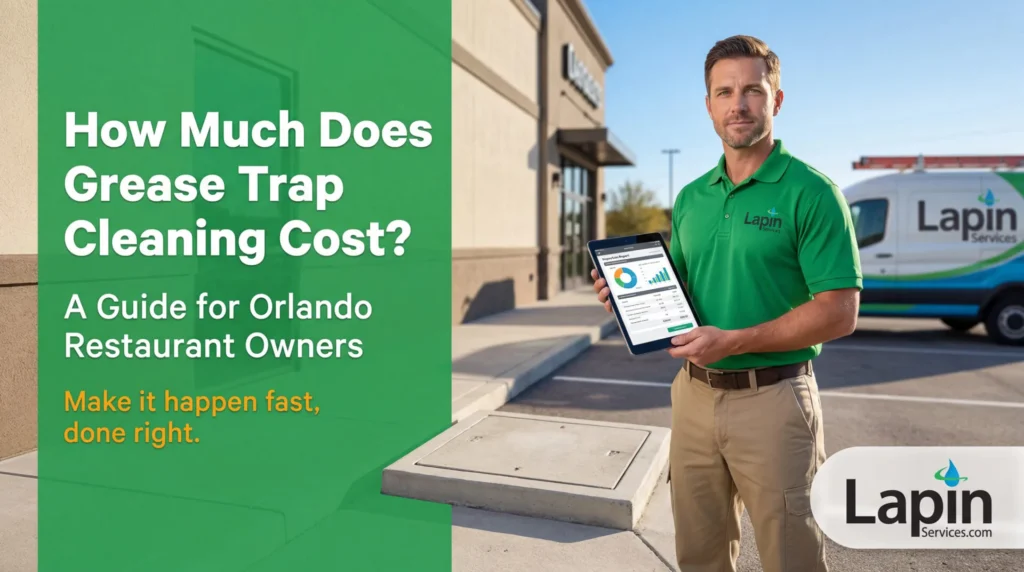
When Orlando restaurant owners and facilities managers start shopping for grease trap service, the first question is usually what they’re actually getting — and how to tell a complete service from one that cuts corners. It’s a reasonable question, and it deserves a direct answer, along with the context that makes it useful for planning and vendor evaluation.
What your grease trap program should look like depends on several variables specific to your operation. Understanding those variables is what separates a restaurant owner who plans accurately from one who gets surprised by backups, failed inspections, and emergency calls.
What Shapes Your Grease Trap Service Needs
The single biggest factor is trap size. Commercial grease traps in the Orlando area are most commonly installed in the 1,000 to 1,500 gallon range, though larger food service operations — hotel kitchens, institutional cafeterias, high-volume casual dining — often run traps in the 2,000 to 3,200 gallon range, and some facilities operate two or three tanks in series. A larger trap holds more waste, requires more time and vacuum capacity to pump, and generates more material requiring licensed disposal. A 1,200-gallon trap and a 2,500-gallon trap are not serviced the same way, and any service plan that doesn’t account for your specific trap size isn’t a reliable plan.
Service frequency is the second major variable. Counties across Central Florida — Orange, Osceola, Seminole, and Lake — require grease traps to be serviced at least once every 90 days. For a restaurant at or near that minimum interval, four service visits per year is the baseline. But high-volume operations servicing their traps every 30 to 45 days will see that annual visit count climb to eight, ten, or more. The right interval is set by your kitchen’s output, not by the regulatory minimum alone.
The scope of what’s included in each visit matters more than most operators realize when comparing providers. A complete service visit includes:
- Full pump-out of the trap
- Interior pressure washing
- Inspection of baffles and inlet and outlet tees
- Compliant disposal with manifest documentation
That is not the same thing as a pump-out only. Some providers pump the trap and call it done, leaving pressure washing and component inspection out of the visit. When you’re comparing providers, confirming exactly what each visit covers is worth the five-minute conversation, because a provider that skips pressure washing is delivering an incomplete service on every visit.
Disposal is part of the service, not an afterthought. All grease trap waste must be transported to and processed at an approved reclamation or recycling facility in compliance with Florida Department of Environmental Protection requirements. Confirm that your provider handles disposal through an approved facility and documents it on a manifest at every visit before you sign a service agreement.
The Annual Maintenance Picture
For a typical single-location Orlando restaurant with a standard 1,200 to 1,500 gallon grease trap, quarterly service covers most scenarios. Higher-volume operations should plan for more frequent visits — a restaurant cleaning its trap six times per year is responding appropriately to the kitchen output driving that frequency.
Routine maintenance is the foundation of compliance and prevention. It keeps the trap functioning, the documentation current, and the drain lines clear. What it does not cover is repair work, which is triggered by condition rather than schedule. Baffles, inlet and outlet tees, and deflection devices are all serviceable components that wear over time. Catching them during a routine inspection and replacing them as needed is far less disruptive than discovering a failed component during a backup or a compliance inspection. Most component-level repairs are straightforward jobs that become serious problems only when they’re deferred long enough to affect the tank structure or cause a downstream issue.
For restaurant operators managing multiple locations, a service agreement that covers every property on a coordinated schedule is far simpler to manage than individual per-location arrangements. If you’re operating two or more Central Florida locations that all need quarterly grease trap service, that’s a conversation worth having with your provider before signing individual agreements for each site.
The Real Risk of Skipping Maintenance
When grease trap maintenance lapses, the consequences are not gradual — they tend to arrive all at once and at the worst possible time.
An emergency grease trap pump-out called in on short notice — typically because a backup has already developed or an inspection is imminent — means scrambling for expedited service at the worst possible moment, and it happens entirely because a routine maintenance schedule wasn’t followed.
Kitchen backups caused by grease trap failure don’t just create a plumbing problem. They create a service interruption. A full-service restaurant that can’t operate its kitchen while a drain problem is remediated loses business for every hour the kitchen is down — and a lost dinner service or weekend outweighs the inconvenience of routine maintenance many times over.
On the compliance side, documented lapses in grease trap service create exposure during county inspections and health department reviews. FOG compliance violations in Florida can bring significant fines depending on the severity and duration of the violation, and a history of noncompliance can affect licensing and permitting decisions. The hauler manifests your service provider generates at each visit are your paper trail. Gaps in that trail are gaps in your compliance record, and inspectors notice them.
Service Contracts vs. On-Demand Service
Most restaurant operators are better served by a service agreement than by scheduling one-off visits as needed. A service agreement delivers several advantages:
- Puts your trap on a fixed maintenance calendar that doesn’t require you to track intervals and initiate calls
- Ensures compliance documentation is generated consistently and kept on file
- Typically comes with faster response times when something outside the routine schedule needs attention
- Gives you a single point of accountability for scope, documentation, and follow-up
The meaningful questions when evaluating a service contract are what the agreement covers in terms of scope per visit, whether documentation and manifest filing are included, how repair work that falls outside routine service is handled, and whether multi-location coordination is available if your operation has more than one site.
A contract that delivers only pump-outs without pressure washing, component inspection, or documentation support isn’t a good contract, no matter how it’s packaged. What you’re actually getting is a compliance program, not just a pumping schedule, and the contract should reflect that.
Frequently Asked Questions
How often does a grease trap need to be serviced in Orlando?
Orange, Osceola, Seminole, and Lake counties require service at least once every 90 days. High-volume kitchens often need service every 30 to 45 days, and a qualified provider can recommend the right interval based on your trap size and kitchen output.
What should a complete grease trap service include?
Every visit should include a full pump-out, interior pressure washing, inspection of baffles and inlet and outlet tees, and compliant disposal with manifest documentation. A pump-out alone is not a complete service.
Does grease trap service include compliance documentation?
It should. Hauler manifests documenting each service, waste volume, and disposal facility are required for county compliance, and a reputable provider includes that documentation as part of the service. Confirm this before signing any service agreement — if documentation is treated as a separate service, that’s a red flag.
How do I avoid emergency grease trap service?
Stay on a routine maintenance schedule matched to your kitchen’s volume. Emergency calls almost always follow missed or stretched service intervals, and a fixed service agreement is the most reliable way to prevent them.
Is a grease trap service contract worth it for a small restaurant?
For most operations, yes. A contract locks in consistent service timing and ensures documentation is generated automatically. The alternative — managing the schedule manually and calling in service as needed — creates the exact compliance gaps that lead to fines and emergency service calls.
What’s the difference between servicing a 1,200-gallon and a 2,500-gallon grease trap?
Larger traps require more time, more vacuum capacity, and generate more material requiring licensed disposal, so service visits are longer and more involved. If you’re unsure of your trap size, a service provider can confirm it during the first visit.
Getting the Right Service Plan for Your Operation
The most useful thing any restaurant owner or facilities manager can do before committing to a grease trap service provider is ask for a service plan that reflects their actual situation — trap size confirmed, service frequency appropriate to kitchen volume, full scope of each visit documented, and compliance handling clearly described. A provider who proposes a schedule without knowing your trap size isn’t giving you a real plan.
Lapin Services serves restaurants, commercial kitchens, hotels, and food service operations across Orlando and Central Florida with full-service grease trap maintenance, complete compliance documentation, and repair capability for any trap condition that develops between or during service visits. We handle hauler manifests for all county requirements in the region and offer coordinated maintenance programs for multi-location operators.
Contact Lapin Services at (407) 326-3367 to set up grease trap service built around your operation.