Why Surge Loading Overwhelms Commercial Septic
- Surge hydraulic loading: Simultaneous morning dumps and laundry usage overwhelm commercial septic tank liquid retention capacity, forcing un-settled solids directly into the drainfield.
- Chemical biological kill-off: RV holding tank additives containing formaldehyde and quaternary ammonium destroy beneficial anaerobic bacteria, halting organic waste digestion and causing rapid biomat blinding.
- High water table backpressure: Osceola County’s elevated groundwater table reduces capillary soil absorption, exerting hydrostatic pressure that prevents effluent from exiting drainfield headers.
- Emergency field remediation: Immediate dual-vacuum pump-outs, high-flow low-PSI hydro-jetting, and lift station transducer recalibration restore systemic hydraulic flow before environmental fines occur.
What Causes Sudden Septic Tank Flooding in Kissimmee RV Parks?
When a 120-site RV park in Kissimmee experiences a sudden Saturday morning sewage backup during peak tourist season, the resulting crisis is far more complex than a standard residential clog. Hundreds of gallons of greywater and blackwater can surge out of ground-level cleanouts, inundating park pads, threatening local stormwater retention basins, and triggering immediate Florida Department of Environmental Protection (FDEP) health violations. Solving this infrastructure breakdown requires a deep understanding of multi-unit commercial hydraulics, soil saturation mechanics, and specialized equipment deployment.
What Primary Factors Trigger Emergency Commercial Septic System Flooding in Multi-Unit RV Parks?
Section Overview: Sudden commercial septic tank flooding in Kissimmee RV parks is caused by extreme hydraulic surge loading during peak guest usage, chemical destruction of anaerobic bacterial colonies from RV holding tank deodorizers, elevated groundwater tables in Osceola County soils, and mechanical failures within commercial lift station pumps or check valves. These combined forces blind drainfield soil interfaces and force raw effluent backward through collection mains.
Commercial septic systems serving mobile home communities and RV resorts operate under vastly different mechanical and biological dynamics than single-family residential setups. When these systems fail, the cause is rarely isolated to a single clogged line. Instead, it is typically a cascading failure involving hydraulic overload, toxic chemical influx, and subterranean environmental pressure.
The Mechanics of Peak Hydraulic Surge Loading
Hydraulic surcharging occurs when liquid wastewater enters the septic tank at a flow rate that exceeds the liquid-solid separation velocity of the primary tank chamber. In a standard Kissimmee RV resort, guest water usage is concentrated into narrow morning and evening windows when dozens of campers simultaneously discharge 40-gallon blackwater holding tanks, run high-efficiency showers, and operate commercial site laundromats.
This concentrated volume creates violent fluid turbulence inside the septic tank. Instead of allowing heavy solids to settle into the bottom sludge layer and light fats, oils, and grease (FOG) to float into the surface scum blanket, the turbulent surge suspends particulate matter. These suspended solids are swept directly past the outlet baffle wall into the effluent distribution box and downstream drainfield headers, physically plugging the soil absorption interface.
Holding Tank Chemical Toxicity and Biomat Maturation
RV holding tank treatments rely heavily on chemical biocides—including formaldehyde, glutaraldehyde, quaternary ammonium compounds, and synthetic surfactants—designed to stop organic decomposition and mask odors in small holding tanks. When hundreds of vehicles dump these concentrated chemicals into a shared commercial septic tank, they destroy the delicate anaerobic microorganism population required to break down complex organic waste.
Without active bacterial digestion, the biochemical oxygen demand ($BOD_5$) and total suspended solids ($TSS$) of the tank effluent skyrocket. As this untreated, nutrient-dense effluent trickles into the drainfield aggregate, it feeds an anaerobic slime layer known as a biomat. While a thin biomat is normal, chemical bio-kill combined with high TSS causes hyper-accelerated biomat growth. The biomat turns into an impermeable biological seal, blocking water from percolating into the surrounding sand and forcing wastewater back up into the park’s collection pipes.
Osceola County Soil Mechanics and High Water Table Hydrostatics
Kissimmee and the broader Osceola County region sit atop poorly drained, sandy soils—predominantly Myakka, Immokalee, and Smyrna sand series—characterized by a naturally high seasonal high-water table (SHWT). During Central Florida’s intense rainy season, atmospheric precipitation rapidly saturates the upper soil horizons, raising the local water table to within inches of the surface.
This elevated water table destroys the unsaturated vertical separation zone required beneath the drainfield absorption trench. Under ideal dry conditions, effluent trickles down through at least 24 inches of unsaturated sandy soil, allowing oxygen to oxidize pathogens. When the water table rises:
- Capillary action ceases: The soil pores become completely filled with groundwater, eliminating capillary tension and stopping the downward percolation of septic effluent.
- Hydrostatic uplift occurs: Groundwater exerts upward hydraulic head pressure against the underside of the drainfield trench and concrete septic tanks.
- Effluent stalls: The septic tank loses its gravity-fed hydraulic differential; water cannot leave the outlet pipe because the receiving soil is already hydraulically saturated, causing rapid water accumulation inside the tank.
Mechanical Failures in Commercial Lift Station Assemblies
Because many Kissimmee RV parks span large geographical acreages with minimal natural slope, they rely on commercial lift stations to pump wastewater from lower collection points up into centralized septic tanks or advanced treatment units. A failure within this mechanical hub results in immediate, large-scale flooding across the site.
Common mechanical failure points include:
- Submersible pump impeller binding: Non-biodegradable wipes, shop towels, and heavy debris flushed by park visitors jam the vortex or cutter impellers of high-head submersible solids-handling pumps, causing thermal overload breakers to trip.
- Transducer and float switch fouling: Grease build-up and floating scum coat mechanical float switches or submersible pressure transducers, tricking the control panel into believing the wet well is empty when it is actually overflowing.
- Check valve hydraulic slam: Worn or jammed check valves on the force main discharge line allow pumped effluent to cascade backward into the wet well every time the pump cycles off, causing rapid re-flooding and continuous pump cycling.
Property managers facing these cascading structural failures rely on rapid diagnostic interventions. When main lines back up across an entire property, immediate septic system problem diagnostics are critical to determine whether the breakdown stems from a mechanical pump failure, a main line block, or total soil field saturation.
How Do Engineering Crews Perform Rapid Emergency Commercial Septic Tank Flooding Repair?
Section Overview: Emergency commercial septic tank flooding repair requires a multi-stage field engineering strategy: deploying high-capacity vacuum tankers to evacuate excess liquid, scouring collection mains with high-flow hydro-jetting, clearing blinded drainfield headers, and troubleshooting duplex lift station controls. Master contractors stabilize the site immediately to prevent raw sewage discharge and restore hydraulic equilibrium.
When an RV park experiences a total septic failure, time is the single most critical variable. Raw sewage pooling on surface soil creates an immediate public health hazard, violates Florida Administrative Code Chapter 62-6, and threatens local water bodies. Resolving the crisis requires systematic diagnostic execution rather than superficial pump-outs.
Stage 1: Emergency Mass-Volume Pumping and Hydraulic Isolation
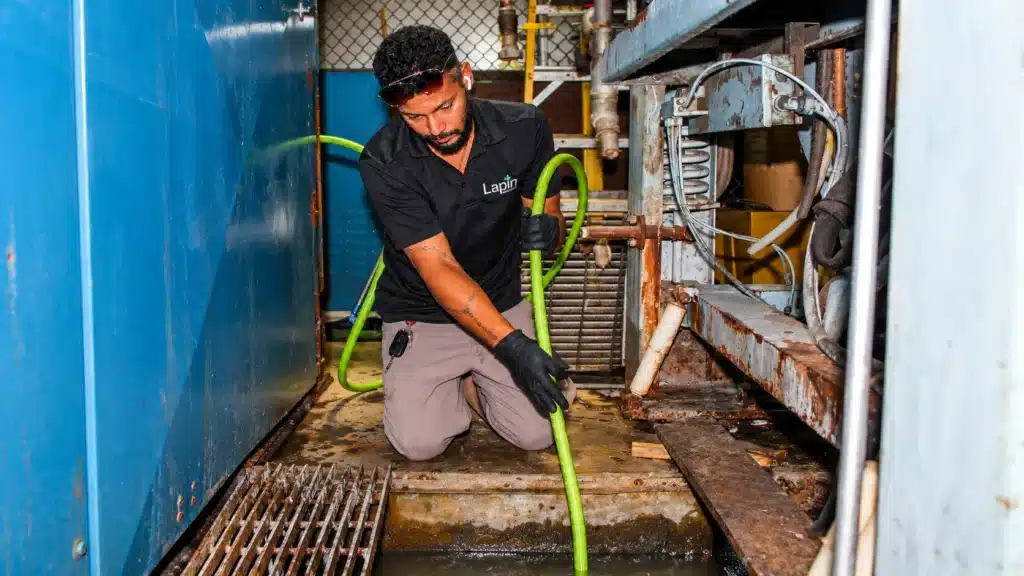
The first priority during a commercial flooding event is removing liquid pressure from the collection network to prevent indoor building backups and surface contamination. Lapin Services dispatches heavy-duty vacuum tanker units capable of pulling thousands of gallons of liquid sludge and floatable solids per minute.
Field crews perform a full-volume pump-out of primary settling tanks, secondary dosing chambers, and lift station wet wells. By drawing the liquid level inside the tanks down below the inlet invert pipe, engineers create temporary hydraulic storage capacity. This immediately relieves backpressure on the park’s collection mains, allowing gravity lines to drain and giving technicians clear access to inspect structural tank components, baffle walls, and inlet/outlet tees.
Stage 2: High-Flow Hydro-Jetting and Line Scouring
Once the standing liquid volume is reduced, crews address pipe blockages caused by accumulated grease, mineral scale, and heavy solids settling in low-velocity collection runs. Standard mechanical cabling or snaking is insufficient for large-diameter commercial sewer lines; engineers utilize industrial high-pressure hydro-jetting.
Hydro-jetting units balance gallons per minute (GPM) water volume with pounds per square inch (PSI) water pressure to achieve safe, thorough cleaning:
- Piping material tolerances: Vintage vitrified clay pipe (VCP) and thin-wall PVC lines are scoured at lower pressures (1,800 to 2,200 PSI) using high-volume reverse-thrust nozzles to prevent pipe wall fracture. Heavy Schedule 40 or 80 PVC lines can withstand up to 3,000–3,500 PSI.
- GPM scouring power: High GPM flow (15 to 25+ GPM) is crucial because water volume, rather than raw pressure, flushes heavy debris and emulsified grease out of large-diameter 6-inch and 8-inch commercial mains.
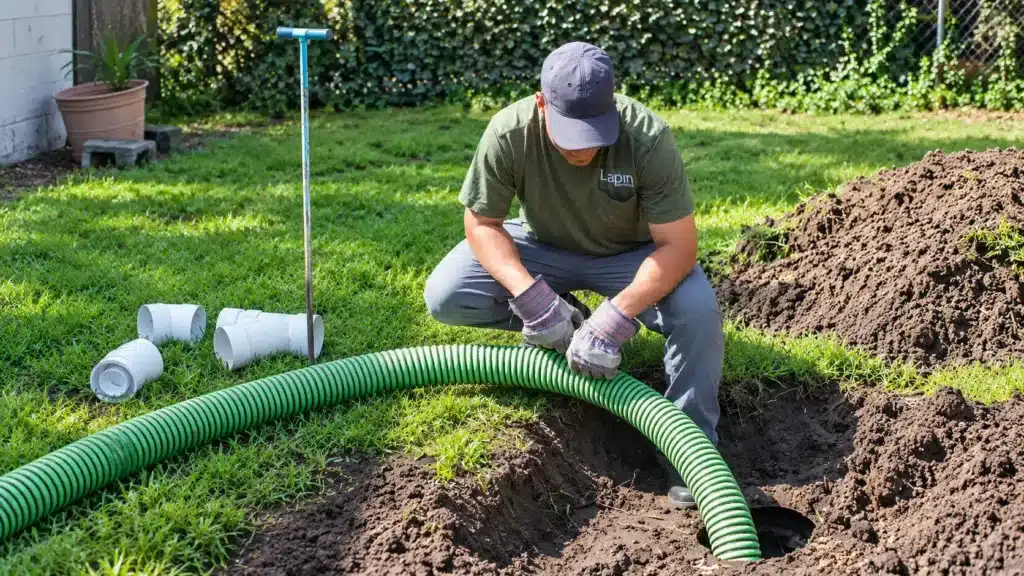
- Effluent header clearing: Technicians run specialized jetter heads into the drainfield distribution box and perforated header lines to clear accumulated biomat debris and sediment without disturbing the surrounding gravel or soil envelope.
When main line blockages involve crushed underground infrastructure, structural pipe collapse, or root intrusion, facility managers must transition from emergency clearing to permanent underground utility repair to restore long-term hydraulic integrity.
Stage 3: Commercial Lift Station Recalibration and Force Main Testing
If the RV park relies on a pumped system, field technicians conduct comprehensive electrical and hydraulic diagnostics on the commercial lift station assembly. This phase ensures that liquid can be reliably moved from collection basins to treatment zones without future surcharging.
Technicians execute the following verification sequence:
- Amp draw and winding testing: Measuring electrical current draw on all pump phases using clamp meters to detect motor winding degradation or partial impeller jams.
- Transducer and float level setting: Cleaning submerged float switches with high-pressure water and recalibrating ultrasonic or static pressure transducers inside the control panel.
- Force main pressure head verification: Checking inline pressure gauges along the force main during pump operation to verify that operating head pressure matches system design curves, ensuring check valves are sealing properly against backflow.
For large commercial properties, routine maintenance of these electrical and mechanical components is essential. Implementing structured commercial lift station maintenance prevents unexpected float failures and pump burnout during high-occupancy holiday weekends.
Stage 4: Drainfield Aeration, Resting, and Environmental Compliance
If the primary drainfield has suffered severe hydraulic saturation due to high water tables or biomat blinding, pumping the tank alone will not fix the underlying soil absorption problem. The drainfield aggregate must be allowed to rest and de-water.
Engineers may install temporary effluent bypass piping or utilize secondary reserve drainfield beds (if available via distribution valves) to divert incoming flow. In severe cases, technicians execute shock oxidation or physical soil aeration around trench perimeters to introduce oxygen, accelerating the aerobic breakdown of organic biomat layers. Throughout this process, field operations must strictly adhere to regulatory guidelines enforced by the Florida Department of Environmental Protection and local county health departments.
When catastrophic failure strikes and wastewater poses an immediate site hazard, property operators can rely on Lapin Services’ 24/7 dispatch for emergency septic pumping service to stabilize the property and prevent severe environmental contamination.
Key Takeaways
- Surge loading drives solid carryover: High peak water usage in RV parks disrupts settling mechanics inside commercial septic tanks, pushing suspended solids into drainfield trenches.
- RV chemicals destroy biological digestion: Biocides like formaldehyde kill essential anaerobic bacteria, causing rapid biological blinding (biomat formation) across soil absorption surfaces.
- Florida soils require water table awareness: High seasonal water tables in Osceola County create hydrostatic backpressure that stops gravity drainfield percolation.
- Hydro-jetting requires GPM and PSI balance: Clearing commercial collection mains requires high water flow (GPM) matched safely to pipe material PSI tolerances.
- Lift station maintenance prevents total shutdown: Regular testing of submersible pumps, float switches, and force main check valves is critical for commercial wastewater management.
Don’t let a sudden septic surge or lift station failure stop operations at your commercial facility, RV park, or multi-family property. Lapin Services brings over six decades of Central Florida engineering experience, holding triple master licenses in septic contracting (SM0890812), plumbing (CFC1428594), and underground utilities (CUC1223686). Whether you need emergency high-volume tank pumping, high-pressure line hydro-jetting, or a complete commercial infrastructure evaluation, our emergency field crews are available 24/7. Contact our emergency septic response team today to request an immediate on-site diagnostic inspection or schedule a comprehensive commercial maintenance plan.