Reading the Ground Above a Failing Pipe
- Subsurface structural failures in Sanford stormwater pipes often begin as minor joint separations, rapidly accelerating during Central Florida’s intense summer squalls.
- Key visual indicators include sudden soil depressions, localized parking lot pavement cracking, persistent surface flooding, and localized sinkhole formation near drainage easements.
- Underground pipe collapses undermine adjacent civil infrastructure, requiring immediate video pipe inspection, trenchless lining, or full excavation to restore site hydraulic capacity.
- Proactive diagnostic evaluations by triple-licensed contractors protect commercial real estate, multi-family housing, and municipal utilities from catastrophic structural liability.
Understanding Underground Stormwater Pipe Failures in Central Florida
During a typical Central Florida summer thunderstorm, thousands of gallons of heavy surface runoff surge through Sanford’s commercial and municipal stormwater infrastructure in a matter of minutes. When an underground stormwater pipe loses its structural integrity beneath a busy parking lot, a residential homeowners association green space, or a commercial development site, the consequences can be catastrophic for the entire property parcel. An unnoticed joint displacement, structural stress fracture, or complete crown failure within a corrugated metal pipe, reinforced concrete culvert, or high-density polyethylene storm pipe can quietly wash away tons of supporting soil long before obvious surface symptoms appear.
For property managers, multi-family facility directors, civil site developers, and commercial land owners across Seminole County, recognizing the earliest visual and hydraulic indicators of an underground stormwater pipe collapse is the primary defense against sudden sinkhole formation, structural foundation damage, and massive financial liability.
When subsurface drainage infrastructure fails, the surrounding soil matrix collapses directly into the compromised pipe path, creating an uncompacted subterranean void directly beneath your asphalt pavement or surface turf. This growing structural void deprives top-level pavements and heavy traffic zones of their foundational load support, resulting in severe surface subsidence, recurring standing water, and eventual structural failure of adjacent utilities or nearby buildings. Identifying these compromised conveyance corridors early allows site managers to execute targeted repairs before a localized pipe failure transforms into an expansive, site-wide civil infrastructure emergency.
What Are the Primary Physical Indicators of a Sanford Stormwater Pipe Failure?
Section Overview: An underground stormwater pipe collapse in Sanford, Florida manifests physically through sudden ground subsidence, localized pavement cracking, localized sinkhole formation, and unexplained soil erosion along drainage easements. These visual symptoms occur as stormwater escapes broken joints, eroding surrounding soil matrices and undermining structural sub-bases, especially during heavy rainfall events over sandy Central Florida soils.
Central Florida’s unique environmental geology and hydrology directly amplify the visible warning signs of subsurface drainage failure. Sanford sitework rests upon fine, highly mobile sandy soil layers situated over a naturally high water table. When an underground storm pipe cracks under structural load or separates at the joints, flowing stormwater exfiltrates into the surrounding soil embankment during heavy rains, or groundwater infiltrates the pipe during dry periods, drawing surrounding earth inside. In either direction, the structural stability of the ground above vanishes rapidly. Property owners and facility managers should regularly monitor their grounds for several distinct physical warning indicators:
Visual Indicators of Subsurface Pipe Failure
- Localized Soil Depressions: Linear dips, sunken turf, or bowl-shaped depressions appearing directly above known utility corridors or between storm inlet structures signal that sandy topsoil is actively washing down into a broken stormwater line.
- Asphalt Cracking and Pavement Subsidence: Spiderweb cracking, structural rutting, or sudden dropping of pavement surrounding catch basins, dumpster pads, and driving aisles indicates that the compacted limerock sub-base has been eroded by subsurface pipe leaks.
- Sudden Sinkhole Development: In severe cases, ongoing soil migration creates a massive underground cavity that eventually collapses under its own weight or under heavy vehicular traffic, creating a hazardous open sinkhole directly over the compromised storm pipe.
- Sinkhole-Like Drop-offs Near Outfalls: Severe soil erosion and earth drop-offs around retention pond control structures, concrete headwalls, and pipe outfalls point directly to joint failure or pipe wall collapse near the discharge terminus.
- Excessive Siltation Inside Catch Basins: Large accumulations of sand, silt, and washed-out Florida soil inside downstream storm structures prove that surrounding earth is entering the conveyance system through structural pipe ruptures.
In multi-family apartment complexes near Lake Monroe or commercial retail hubs along Rhinehart Road, these structural symptoms almost always start small. A minor dip in the asphalt near a delivery bay or a soft, soggy patch of grass in an HOA common area might initially seem like simple natural soil settlement. In reality, thousands of gallons of pressurized storm runoff during afternoon squalls are actively scouring out the compacted sub-base beneath, turning what could have been a simple pipe restoration into a full-scale sitework reconstruction project.
The Step-by-Step Mechanism of Underground Soil Erosion
To understand how a small pipe crack turns into a massive surface depression, property owners must understand the four distinct stages of subsurface erosion in sandy Florida soils:
- Initial Pipe Compromise: Heavy traffic loads, ground shifting, or high water table hydraulic pressure causes a joint separation or a structural crown crack in the underground stormwater pipe.
- Soil Infiltration and Scour: During heavy downpours, stormwater gushes out through the pipe breach, saturating the surrounding limerock base and sandy soil. As the water recedes, fine sand particles are drawn back into the pipe and washed away downstream.
- Subterranean Void Formation: As sand continuously migrates into the storm line with every rain cycle, an invisible, empty subterranean cavity forms directly above the pipe breach while the surface asphalt or grass initially remains intact.
- Surface Collapse: The unsupported surface layer eventually reaches its structural breaking point under its own weight or the weight of passing vehicles, resulting in sudden pavement cracking, severe ground subsidence, or a dangerous sinkhole.
When visual surface changes align with heavy rainfall events, immediate diagnostic intervention is necessary to prevent complete loss of site structural integrity. Contacting experienced specialists in flooding & stormwater issuesallows property managers to isolate the point of failure before subsurface voids undermine neighboring building foundations, parking structures, or municipal right-of-ways.
How Does a Collapsed Stormwater Line Cause Severe Site Flooding and Utility Damage?
Section Overview: A collapsed stormwater pipe restricts hydraulic conveyance capacity, causing storm runoff to back up through catch basins and retention basins. The resulting localized flooding inundates surface parking, saturates adjacent septic drainfields, overburdens sanitary sewer lines, and risks severe structural foundation damage due to elevated hydrostatic pressure and unmanaged surface water accumulation.
A collapsed stormwater line acts as an internal dam within your site’s primary drainage network. When structural failure restricts or completely blocks the internal cross-sectional area of a pipe, incoming storm water has nowhere to go except backward into your collection system. During high-intensity rainfall events common to Seminole County, this hydraulic backup triggers a rapid cascade of surface flooding and secondary utility interference across the entire property parcel.
Cascading Hydraulic and Utility Impacts
- Severe Surface Parking Lot Pooling: Runoff rapidly bypasses blocked catch basins, swamping parking bays, driving lanes, and pedestrian walkways, creating major safety hazards and commercial liability.
- Septic Drainfield Hydraulic Overload: Excessive surface water pooling and elevated local water tables prevent nearby septic systems & pumping infrastructure from discharging effluent properly, leading to severe drainfield saturation and domestic sewage backups inside buildings.
- Sanitary Sewer Infiltration: Floodwaters ponding over sewer cleanouts or manholes leak directly into the sanitary sewer infrastructure, overwhelming internal lift station pumps and increasing municipal surcharge risks.
- Structural Foundation Inundation: Uncontrolled surface water pooling near building perimeters forces moisture through concrete slabs, causing costly interior water intrusion and weakening shallow spread footings.
- Erosion of Adjacent Civil Utilities: Uncontrolled subsurface water flow and migrating soil erode structural support around adjacent water mains, gas corridors, and underground electrical conduits, leading to secondary utility failures.
Consider a commercial shopping plaza in Sanford facing persistent, heavy parking lot flooding after standard 30-minute rainstorms. Facility managers may assume catch basins simply need routine debris clearing or vacuum pumping. However, if a 24-inch reinforced concrete storm pipe has offset joints beneath the main entrance, water isn’t clearing because the pipe cross-section is choked with displaced soil and collapsed concrete fragments. Hydrostatic pressure behind the blockage forces water out through remaining pipe gaps, rapidly accelerating subsurface soil loss and creating deep subterranean caverns beneath heavy vehicular traffic lanes.
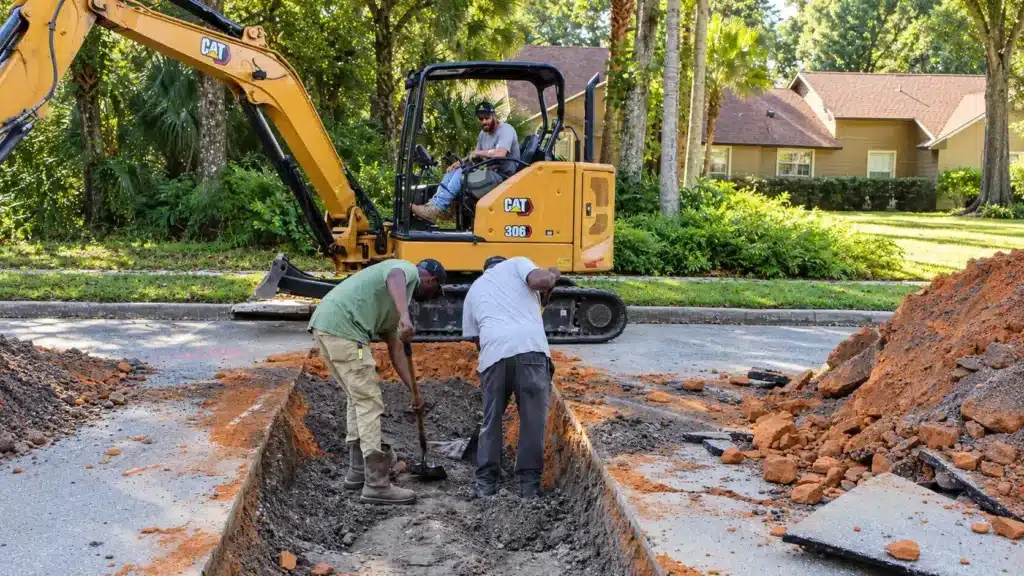
Addressing complex municipal cross-connections, deep excavation, or trenchless repairs requires an experienced partner capable of executing advanced sitework & new construction utilities. Triple-licensed contractors hold the specialized mechanical expertise, heavy excavation machinery, and municipal engineering authorizations required to repair structural drainage failures while ensuring total regulatory compliance with the Florida Department of Environmental Protection (FDEP) and local municipal water utilities.
External References
- Florida Department of Environmental Protection – Stormwater Management Standards
- US EPA – Environmental & Stormwater Discharge Regulations
Key Takeaways
- Watch for Early Visual Indicators: Pavement dips, bowl-shaped soil depressions, and localized asphalt cracking often point directly to underground pipe failure long before a full sinkhole forms.
- Understand the Florida Subsurface: Fine sandy soils and high water tables in Sanford accelerate soil migration into cracked pipes, rapidly expanding subterranean voids under heavy rain loads.
- Recognize Cascading Risks: A collapsed storm line doesn’t just flood parking lots—it overburdens adjacent septic drainfields, floods building slabs, and disrupts underground utility lines.
- Invest in Advanced Diagnostics: High-definition CCTV pipe inspection cameras isolate exact failure points, preventing unnecessary open-cut trenching across entire parking areas.
- Partner with Triple-Licensed Experts: Restoring commercial or residential drainage integrity requires specialized excavation, hydraulic engineering, and strict compliance with FDEP and local Seminole County regulations.
Don’t wait for a localized soil depression to turn into an expensive parking lot collapse or emergency environmental violation. Since 1958, Lapin Services has provided Central Florida property managers, commercial developers, and homeowners with authoritative plumbing, septic, and underground utility expertise. Fully triple-licensed as a Master Septic Contractor (SM0890812), Certified Plumbing Contractor (CFC1428594), and Underground Utility Contractor (CUC1223686), our team has the heavy equipment and diagnostic capability to handle any civil drainage emergency. Request a Project Quote online today, or call our 24/7 emergency dispatch line at (407) 326-3367 to schedule an immediate site evaluation.