
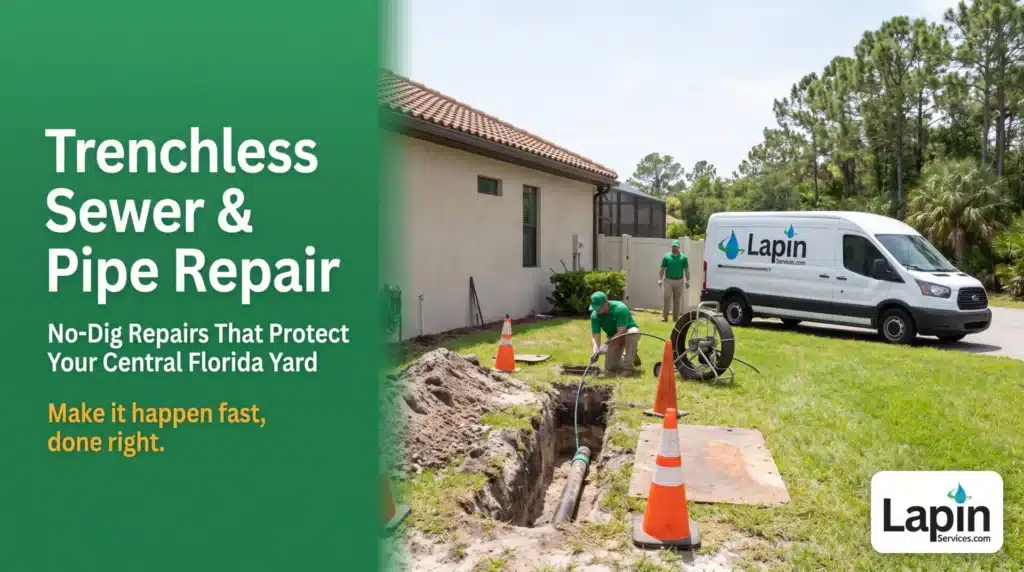
Trenchless sewer repair is better when the existing pipe still holds its shape and line, because it restores the pipe without tearing up your yard, driveway or slab. Traditional digging is better when the pipe has collapsed, sagged into a belly, or sits at the wrong grade. The pipe’s condition decides the method, not preference.
That is why a camera inspection comes first. Lapin camera-diagnoses every sewer line with in-house sewer cameras before recommending a repair method, so the decision rests on what the pipe actually looks like inside rather than a guess from the surface.
What Trenchless Sewer Repair Actually Means
Trenchless sewer repair rebuilds or replaces a buried pipe through small access points instead of an open trench along its full length. Crews typically work from an existing cleanout, a small pit at each end of the run, or both.
There are two main methods, and they solve different problems.
Cured-in-place pipe lining (CIPP)
A resin-saturated liner is pulled or inverted into the old pipe, inflated against the walls, and cured in place. It hardens into a new jointless pipe inside the old one. Cured-in-place pipe lining is the right call for cracked clay, corroded cast iron, root intrusion at joints, and pipes with small offsets.
Lining slightly reduces the interior diameter, usually by a fraction of an inch. On a standard residential lateral, that reduction is offset by the smooth new surface, which often carries flow better than a rough, scaled original pipe.
Pipe bursting
A bursting head is pulled through the old pipe, fracturing it outward while towing a new HDPE pipe into the same path. Pipe bursting replaces the line entirely and can upsize it, for example from 4 inch to 6 inch on a commercial run.
Bursting needs a pit at each end and enough clearance around the pipe path. It is the stronger option when the old pipe is too far gone to serve as a host for a liner.
Trenchless vs. Traditional Dig: Side-by-Side Comparison
Use this to frame the conversation with your contractor. The right answer depends on your specific line, but these are the practical trade-offs.
- Surface disruption. Trenchless needs one or two small access points. A traditional dig opens a trench along the full length of the pipe, which on a typical Orlando lot can run 40 to 80 feet from the house to the street.
- Restoration work. Trenchless usually leaves sod, pavers, mature oaks and driveway concrete intact. A dig means replacing what was removed, and that restoration is frequently the largest line item on the invoice.
- Time on site. Most residential trenchless jobs are completed in a day or two. A full dig-and-replace commonly runs several days, longer if concrete or hardscape has to come out and go back.
- Pipe condition required. Trenchless needs a host pipe that is continuous and reasonably aligned. A dig handles collapsed sections, bellies and grade problems that no liner can correct.
- Cost drivers. Trenchless carries a higher per-foot repair cost but far lower restoration cost. A dig has a lower per-foot repair cost and much higher restoration cost when driveways, patios or landscaping are involved.
- Access requirements. Trenchless needs a usable cleanout or room for entry and exit pits. Tight side yards, fences and utility congestion can rule it out.
- Expected service life. Both methods, done correctly, are long-term repairs rather than patches.
Pipe lining vs. pipe bursting at a glance
- Choose lining when the pipe is cracked, root-infiltrated, corroded or has minor offsets, and the diameter is adequate for the fixture load.
- Choose bursting when the pipe is severely deteriorated, partially collapsed in spots, or undersized for current demand.
- Choose an open dig when the line has a belly holding standing water, has separated at a joint and shifted, or when grade must be corrected.
How Long Does Pipe Lining Last?
Properly installed CIPP liners are engineered as long-term structural repairs, and the same applies to HDPE pipe installed by bursting. Neither is a temporary fix.
Two things drive real-world lifespan more than the product itself:
- Installation quality. Correct cleaning and prep of the host pipe, correct resin mix, correct cure. A liner installed over heavy scale or standing water will not perform.
- What goes down the line afterward. Grease, wipes and heavy solids will foul a new pipe the same way they fouled the old one.
For restaurants and commercial kitchens, that second point matters most. A relined lateral behind a poorly maintained grease interceptor will be back on the schedule sooner than it should be.
The Central Florida Angle: Yards, Driveways and Permits
National trenchless guides skip the part that decides most Orlando jobs, which is what sits on top of the pipe. Central Florida properties have specific conditions worth naming.
Driveways and hardscape
Many Orlando-area laterals run under a concrete driveway or paver apron on their way to the street. Cutting and repouring that section costs real money and leaves a visible seam. Trenchless work that starts at a cleanout near the house and exits past the driveway avoids the cut entirely.
Mature trees and root intrusion
Live oaks, laurel oaks and ficus are the usual culprits behind root intrusion in older Central Florida neighborhoods. Digging near a mature root system can damage the tree and may run into protected tree ordinances depending on the municipality. Lining seals the joints where roots enter without disturbing the root ball.
Sandy soil and high water table
Our soil is sandy and the water table sits high in much of the region. Open trenches at sewer depth often need shoring and dewatering, which adds time and cost. Trenchless reduces the amount of open excavation exposed to those conditions.
Permits, right-of-way and HOAs
Work in the public right-of-way, where your lateral meets the city or county main, carries its own permitting and restoration standards. Municipalities and utilities across Orange, Seminole and Osceola counties each handle this differently. HOA-governed communities frequently have landscape and hardscape restoration rules that make a full-length trench considerably more expensive than the pipe work itself.
What a Sewer Line Repair Costs Depends On
We do not publish prices, because a sewer line quote that ignores the specifics of the property is not a real number. These are the factors that move the figure on any sewer line replacement or repair:
- Length and depth of the run
- Pipe diameter and existing material, such as clay, cast iron, Orangeburg or PVC
- Number of connections, bends and cleanouts along the line
- Surface above the pipe: sod, pavers, concrete, asphalt or structure
- Access for equipment and whether entry and exit pits are workable
- Permitting and right-of-way requirements for your jurisdiction
- Whether groundwater requires dewatering
The honest comparison is total delivered cost, not per-foot repair cost. A dig that quotes lower on the pipe can finish higher once a driveway, irrigation system and landscaping are put back.
Is Trenchless Sewer Repair Worth It?
For most Orlando homeowners with an intact but deteriorated line under a finished yard or driveway, yes. For a pipe that has already failed structurally or sits at the wrong grade, no amount of lining fixes the underlying problem, and an open dig is the responsible recommendation.
Property managers and HOAs tend to value trenchless for a different reason: fewer disrupted units, less closed parking and shorter resident impact. Restaurants weigh it against closed days. Builders and GCs weigh it against schedule.
A contractor who recommends trenchless before running a camera is selling a method rather than solving a problem. Ask to see the video.
How the Decision Gets Made on a Real Job
Here is the sequence that produces a defensible recommendation.
- Camera inspection. A sewer camera runs the full line and locates defects, roots, offsets, bellies and the connection point.
- Locate and depth. The camera head is tracked from the surface to mark the pipe path and depth, which shows exactly what sits above it.
- Method selection. Lining, bursting or open dig, based on pipe condition, alignment, access and diameter needs.
- Scope and permitting. Confirm jurisdiction, right-of-way involvement and restoration standards before work begins.
- Repair and verification. A post-repair camera pass confirms the finished line.
Lapin has worked underground in Central Florida since 1958, across plumbing, septic, sewer and drain and underground utilities. That range matters here, because a sewer problem sometimes turns out to be a septic problem, a grade problem or a utility conflict. You can review the details of our trenchless sewer line repair service in Orlando and see how the diagnostic step fits the repair.
Questions Worth Asking Before You Approve Any Sewer Quote
- Did you camera the line, and can I see the footage?
- What is the pipe material, diameter and depth?
- Is there a belly or grade issue, and if so, how does the proposed method address it?
- Where are the access points, and what surface work is required at each?
- Does this quote include restoration of sod, pavers or concrete?
- Who pulls the permit, and does the work extend into the right-of-way?
- Will you camera the line again when the repair is finished?
If a contractor cannot answer those clearly, the number on the page is an estimate of hope rather than work.
Talk Through Your Line With Lapin
Sewer decisions get easier once you can see inside the pipe. Lapin runs in-house sewer cameras across Orlando and Central Florida, then recommends trenchless lining, pipe bursting or an open dig based on what the line actually needs.
We are family-owned since 1958, BBB A+ rated, carry a 4.9-star reputation across more than 1,300 Google reviews, and answer emergency calls 24/7. Contact us to schedule an inspection and get a written scope for your property.