
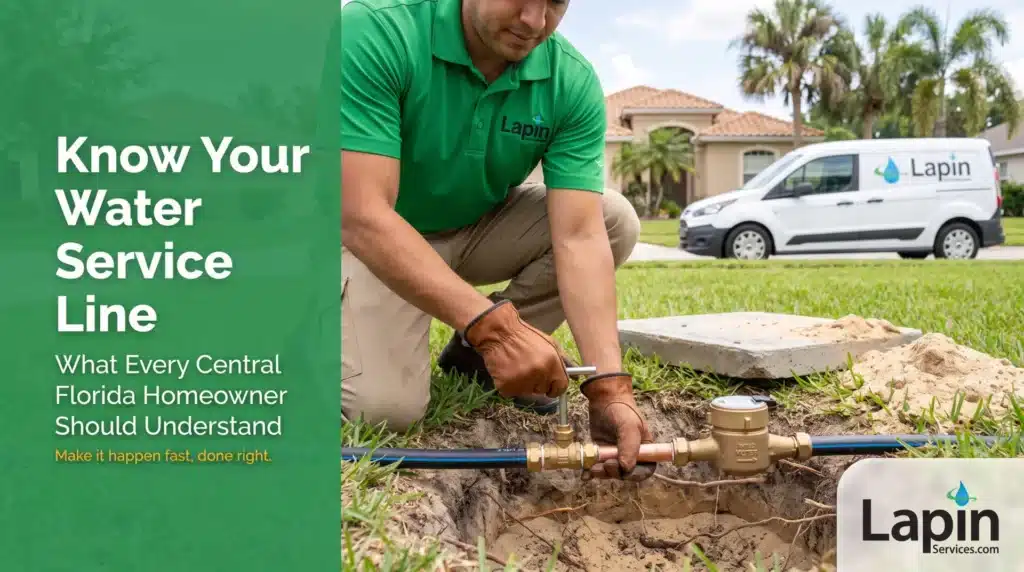
The clearest signs your main water service line needs replacement are a sudden jump in your water bill with no change in use, a wet or soft patch in the yard between the meter and the house, falling water pressure at every fixture, and a meter dial that keeps moving when all water is off. Rust-colored water and repeat repairs on the same line point the same direction.
Who is responsible for the water line to the house?
In most Central Florida service areas, the utility owns the main in the street and the meter itself. The homeowner or property owner owns the line from the meter to the building, along with any leaks, breaks or replacement on that section.
That split is the single most useful thing to know before you spend money. A leak on the utility side is the utility’s repair. A leak on the customer side is yours, and it is your bill that keeps climbing while it runs.
Ownership rules vary by municipality and by utility. Orlando Utilities Commission, Orange County Utilities, Seminole County, Winter Park, Kissimmee and Toho Water Authority each have their own boundary language and their own permit requirements. Call the utility, report the suspected leak, and ask them to check the meter and the service side before you dig.
Two practical notes for property owners and managers:
- If the wet spot sits between the street and the meter, report it and wait. That is usually the utility’s side.
- If the wet spot sits between the meter and the building, that is your water meter to house line and your responsibility to repair or replace.
Water service line leak signs to take seriously
A buried water line leak rarely announces itself the way a burst pipe under a sink does. The water goes into the sand and moves. Watch for these instead.
Signs you can check yourself
- The bill climbs without explanation. A slow leak on a pressurized line runs 24 hours a day and shows up on the meter as real usage.
- The meter moves with everything off. Shut every fixture and appliance, then watch the leak indicator or the lowest dial. Movement means water is escaping downstream of the meter.
- Pressure drops at every fixture at once. One weak faucet is a fixture problem. Weak pressure house-wide points at the service line.
- Wet, spongy or unusually green ground in a line across the yard, often between the meter box and the front of the house.
- Sinkholes, dips or settled pavers along the line path as saturated soil washes out beneath them.
- Discolored water or a metallic taste, common where old galvanized steel is corroding from the inside.
- Repeat repairs on the same pipe. Two or three patches in a few years mean the pipe itself is finished, not that spot.
- Water sound in the wall or at the meter when no one is using water.
What makes Central Florida lines fail
Local conditions do most of the damage. Sandy, shifting soil moves pipe. High water tables keep buried joints wet year-round. Older neighborhoods still carry galvanized steel or thin-wall copper that has been in the ground for decades.
Root intrusion at the trench line, settlement under driveways, and pressure spikes from utility work all add stress. Where a line has already been patched more than once, galvanized water line replacement from meter to house is usually the cheaper decision over five years than one more spot repair.
The water line replacement process, step by step
A clean job follows the same sequence every time. Knowing it helps you tell a thorough contractor from a rushed one.
- Verify the leak and the ownership boundary. Meter test, pressure check at the hose bib, and confirmation of whether the loss is on the utility side or the customer side.
- Locate the existing line. Utility locating marks the path of the water line and everything else buried nearby, including gas, electric, irrigation, cable and sewer.
- Call in the state locate ticket and pull permits. Sunshine 811 notification is required before excavation. Permit requirements and inspection steps depend on your municipality.
- Choose the route and method. Open trench where access is clear, or a bore under driveways, walkways and mature landscaping to limit surface damage.
- Install the new line. Modern service lines are typically copper or approved polyethylene, sized to the fixture load and the length of the run.
- Tie in, pressure test and disinfect. New line is connected at the meter and at the house, tested, and flushed before it goes into service.
- Inspection and restoration. Inspection where the jurisdiction requires it, then backfill, compaction and repair of sod, concrete or pavers.
Most single-family water service line replacement jobs are completed in one day, with water off for only part of it. Long runs, commercial services, deep lines and driveway bores take longer.
Water line replacement cost in Orlando: what drives the number
Nobody can quote a buried line honestly from a phone call. What a contractor can do is tell you which factors move the price, so the estimate makes sense when you see it.
- Length of the run. A 30-foot run from a curbside meter costs far less than a 120-foot run from a meter at the street edge of a deep lot.
- Depth and soil conditions. High water table, hardpan or rock means slower excavation and more site control.
- What sits on top of the line. Driveways, sidewalks, pavers, decorative concrete and mature trees usually push the job toward boring instead of trenching.
- Pipe material and diameter. Upsizing for pressure or for added fixtures costs more than a like-for-like swap.
- Permits and inspections. Fees and required steps differ by municipality and utility.
- Restoration scope. Sod replacement is minor. Matching a stamped concrete driveway is not.
- Commercial factors. Backflow assemblies, meter sizing, traffic control and after-hours work all apply to restaurants, retail centers and multifamily properties.
Expect a written scope that names the pipe material, the route, the method, who pulls the permit and what restoration is included. If a quote leaves restoration vague, ask before you sign. That is where surprise costs live.
Repair or replace?
Repair one clean break in an otherwise sound copper or poly line. That is a straightforward main water line repair and there is no reason to replace good pipe.
Replace when any of the following is true:
- The pipe is galvanized steel and showing rust or restricted flow.
- You have had two or more leaks on the same line.
- Pressure stays low after the leak is fixed, which suggests interior corrosion along the whole run.
- The line is undersized for the building’s current fixture count, which is common after additions or remodels.
- The route runs under something you do not want to open twice.
A full water service upgrade also matters at sale. Realtors and homebuyers in Central Florida see failed service lines flagged during inspection often enough that a documented replacement removes a negotiation point instead of creating one.
Why the in-house crew matters
Water main line replacement is not really a plumbing job or an excavation job. It is both, and the seam between them is where projects go wrong. A plumber who has to subcontract the digging loses control of the schedule, the locating and the restoration.
Lapin runs utility-locating and excavation crews in house alongside the plumbing side. One company locates the line, pulls the permit, digs or bores, installs and tests the new service, handles inspection and puts the yard back. Our underground utility repair team in Orlando handles that work daily across residential and commercial properties.
We have been family-owned since 1958, we are multi-trade across plumbing, septic, sewer and drain and underground utilities, and we answer emergency calls 24/7. We hold a BBB A+ rating and a 4.9-star reputation across more than 1,300 Google reviews.
What to do next
If your bill jumped or your yard is wet, start with two calls. Ask your utility to check the meter and confirm whether the loss is on their side. Then have the customer-side line evaluated so you know whether you are looking at one repair or a full replacement.
Bring the last three water bills, the location of the meter box and any history of previous leaks. That short list turns a guess into a defined scope and a firm number. Call Lapin Services to schedule an evaluation of your water service line anywhere in Orlando and Central Florida.