Why Summer Heat Pushes Sewer Gas to the Surface
- Hydrogen Sulfide Thermal Venting: Afternoon heat causes heavy anaerobic sewer gases trapped under saturated soil to expand and escape through the dry ground surface.
- Hydraulic Surface Pressure: Daily Central Florida summer downpours elevate the shallow water table, sealing soil pores and forcing $H_2S$ gas upwards into your yard.
- Biomat Layer Restriction: A clogged organic biomat restricts effluence absorption, creating standing anaerobic wastewater that off-gasses under direct sunlight.
- Venting System Failures: Malfunctioning plumbing roof stacks or blocked drainfield headers prevent upward dispersion, forcing foul odors out at ground level.
Why Does My Drainfield Smell Like Rotten Eggs Every Summer Afternoon?
A Central Florida homeowner steps onto their patio at 4:00 PM in July, right after a typical torrential downpour, only to be hit by a wave of noxious rotten egg odor wafting from the backyard lawn. The air is thick with humidity, the sun is baking the wet turf, and the smell of sulfur is unbearable. By 8:00 PM, the smell disappears completely, leaving property owners confused about whether they are facing a minor nuisance or an impending catastrophic septic failure.
This recurring afternoon phenomenon is a classic sign of micro-environmental soil physics interacting with Central Florida hydrology. That rotten egg smell is hydrogen sulfide ($H_2S$) gas, a natural byproduct of anaerobic bacterial breakdown occurring inside your septic tank. When ambient temperatures spike and summer downpours saturate the upper soil column, changing atmospheric pressure and hydraulic forces drive trapped sewer gases up through the grass roots. Ignoring these afternoon warning signs often leads to severe drainfield failure, expensive soil remediation, or raw sewage backing up into home fixtures.
What Causes Hydrogen Sulfide Gas to Vent From Central Florida Drainfields in the Summer Heat?
Section Overview: Central Florida’s summer heat and daily rainstorms drive rotten egg smells from septic drainfields through atmospheric inversion, soil saturation, and thermal gas expansion. Rising water tables fill soil pores, forcing anaerobic hydrogen sulfide ($H_2S$) gas upward through the turf. Concurrently, high ambient surface temperatures expand buried gases, driving them out of the soil matrix when local atmospheric pressure drops after late-afternoon thunderstorms.
To understand why hydrogen sulfide vents primarily during summer afternoons, you must examine the biological and physical mechanisms occurring beneath your lawn. Inside your septic tank, anaerobic bacteria process organic waste, producing $H_2S$ alongside methane and carbon dioxide. In a healthy system, effluence flows into the soil absorption field where aerobic bacteria digest remaining pathogens while gases disperse safely into the atmosphere at undetectable concentrations.
When environmental conditions alter soil permeability, this gas matrix becomes trapped and pressurized. Summer afternoon weather creates a perfect storm of environmental conditions that forces these sewer gases out at ground level:
- Shallow Water Table Compression: Central Florida’s water table rises significantly during rainy summer months. As underground water levels surge toward the surface, water fills the void space in sandy soil, trapping sewer gas beneath a liquid barrier and pushing it upward into your yard.
- Thermal Gas Expansion: As afternoon temperatures exceed 90°F, heat transfers into the upper 12 inches of soil. Gas expands as it warms, increasing sub-surface pressure within the drainfield gravel trenches and forcing $H_2S$ up through the path of least resistance.
- Barometric Inversion After Rain: Heavy afternoon thunderstorms bring abrupt drops in barometric pressure. Lower atmospheric pressure above ground acts like a vacuum, pulling high-pressure underground sewer gas upward into ambient air.
- Saturated Soil Pores: When rain saturates topsoil, air can no longer flow downward into the drainfield. Deprived of oxygen, aerobic bacteria die off, allowing anaerobic microbes to dominate and multiply $H_2S$ production exponentially.
If you notice sewage odors accompanied by wet patches or sluggish toilets, schedule an immediate diagnostic review for septic system problems to prevent permanent drainfield destruction.
Step-by-Step Gas Venting Mechanism
Understanding the step-by-step physical cascade helps clarify why this problem peaks during late summer afternoons:
- Daily Rainfall Saturation: Intense tropical downpours instantly saturate the upper topsoil layers, effectively placing an airtight liquid seal over your lawn and causing the shallow subterranean water table to surge.
- Subsurface Thermal Heating: Intense afternoon sunlight heats the ground surface past 90°F, warming the shallow soil beds and expanding the trapped anaerobic gases underneath.
- Barometric Pressure Drops: Post-storm atmospheric pressure drops rapidly, creating a pressure gradient that draws high-pressure underground hydrogen sulfide gas upward through grass root channels.
- Biomat Wastewater Entrapment: A clogged organic biomat restricts liquid percolation along trench walls, keeping stagnant effluent trapped where heat and low pressure pull sulfurous fumes directly into ambient air.
Biomat Formation and Soil Absorption Dynamics
A major underlying cause of summer drainfield venting is the accumulation of a thick biomat layer along the trench bottom. Biomat is a dense, anaerobic slime layer composed of organic solids, dead bacteria, and polysaccharide polymers. While a thin biomat layer is normal and helps slow liquid flow for biological filtration, an overgrown biomat prevents effluence from penetrating the sandy soil matrix.
When effluence cannot drain downward due to biomat clogging, it pools within the drainfield pipe system. Summer heat bakes this stagnant, organic-rich wastewater, turning the drainfield into an active fermentation chamber. The resulting hydrogen sulfide gas accumulates rapidly, escaping into the lawn when the upper soil dries out slightly under direct afternoon sun.
Mechanical Venting and Plumbing Stack Blockages
Atmospheric pressure drops during summer storms normally force sewer gases to exit safely through your roof vent stack. However, when roof vents become obstructed by bird nests, leaves, or mud daubers, high-pressure gases cannot escape upward. Instead, pressure builds inside the house plumbing and forces gas backward out through drainfield headers, septic tank lids, or dry indoor P-traps.
When roof stack venting fails alongside a saturated drainfield, sewer gas follows plumbing lines straight back into your living space, creating severe indoor air quality hazards and triggering bad odors & sewer gas issues throughout the property.
Commercial Facility Impacts and FOG Interference
Summer drainfield failure is not limited to single-family homes. Commercial facilities, multi-family communities, and restaurants face severe operational risks when high seasonal temperatures interact with wastewater infrastructure. In commercial kitchens, fats, oils, and grease (FOG) entering the wastewater stream pass through interceptors and coat downstream drainage lines or drainfields.
During hot weather, grease deposits inside lines undergo chemical breakdown, producing volatile fatty acids and rancid hydrogen sulfide gases. When paired with heavy commercial usage during peak hours, overloaded systems can experience catastrophic backups. Commercial property managers must maintain strict grease interceptor pumping schedules to comply with local utility guidelines established by the Florida Department of Environmental Protection (FDEP) and local municipal water codes.
Failure to control FOG discharges and inspect sub-surface infrastructure can quickly lead to emergency health department shutdowns or costly site restoration projects. Multi-family housing complexes and retail plazas should partner with specialists for professional commercial grease trap services in Orlando to protect downstream plumbing assets.
How Can Property Owners Resolve Summer Drainfield Odors and Prevent System Failure?
Section Overview: Property owners can eliminate summer drainfield odors by clearing roof vent blockages, reducing indoor water usage during peak afternoon hours, and getting professional tank pump-outs. Long-term fixes require mechanical hydro-jetting to remove drainfield line scale, installing effluent filters, or replacing saturated soil beds with modern engineered systems that accommodate Central Florida’s high water tables and heavy summer rainfall.
Addressing summer rotten egg smells requires a systematic approach that isolates mechanical failures from environmental and biological causes. Pouring store-bought chemical septic additives or bleach down your drains will not solve the issue; in fact, aggressive chemicals destroy beneficial soil bacteria, exacerbate biomat buildup, and accelerate drainfield failure.
Instead, property owners and facility managers must rely on proven engineering methods, mechanical diagnostics, and disciplined water management practices to restore proper function.
Immediate Tactical Diagnostics for Property Owners
When rotten egg odors manifest on summer afternoons, take these immediate diagnostic steps to protect your plumbing infrastructure:
- Inspect Indoor P-Traps: Run water in guest bathrooms, utility sinks, and floor drains that are rarely used. Dry P-traps allow sewer gas from the septic tank to vent directly into indoor spaces.
- Check Roof Vent Terminals: Safely inspect roof stack pipes for physical blockages like leaves, rodent nests, or wasp hives that prevent gas from escaping skyward.
- Monitor Water Consumption: Reduce laundry cycles, dishwasher runs, and long showers during intense summer rainstorms. Excess water loading drives effluence straight up to the soil surface when groundwater levels are high.
- Locate Surface Pooling: Walk your drainfield area to check for spongy soil, unusually green grass patches, or standing dark water, which indicate advanced hydraulic failure.
- Check Tank Lid Seals: Ensure concrete or PVC septic tank risers are properly sealed with watertight gaskets to prevent surface runoff from entering the tank and sewer gas from escaping at ground level.
If you spot standing wastewater or experience sewage backups into ground-floor showers during heavy rains, call a technician immediately for 24/7 emergency services to prevent structural damage.
Professional Remediation and Mechanical Restoration
When simple fixes do not resolve the smell, professional intervention is necessary to restore drainfield absorption capacity. Specialized contractors use high-definition video sewer cameras to inspect header pipes and drainfield lines for crushed conduits, root intrusion, or heavy biomat buildup.
Depending on the condition of your infrastructure, licensed professionals employ several mechanical solutions:
- Precision Hydro-Jetting: High-pressure water jetting (using specialized GPM-to-PSI ratios calibrated to protect delicate pipes) scours organic sludge, grease deposits, and roots out of distribution lines without excavating your lawn. Property owners can schedule sewer & drain services to clear these stubborn line obstructions.
- Effluent Filter Installation: Installing a sanitary effluent filter on the septic tank outlet baffle prevents suspended solids and hair from entering the drainfield, dramatically extending its operational lifespan.
- Aerobic Bacterial Inoculation: Professional-grade biological treatments introduce targeted aerobic bacteria that actively digest the excess biomat layer without harming soil ecology or groundwater quality.
- Lift Station Pump Maintenance: Commercial sites and deep-bed residential systems relying on lift stations require routine pump, float, and transducer maintenance. You can arrange comprehensive care through dedicated commercial lift station services in Orlando.
According to wastewater guidelines from the U.S. Environmental Protection Agency (EPA), proper maintenance and timely solids removal are the single best investments for preventing costly soil absorption field replacements.
Comparative Infrastructure Breakdown: Conventional vs. Elevated Mounded Systems
When evaluating permanent solutions for severe summer drainfield failure caused by Central Florida’s hydrology, comparing conventional buried systems with engineered mounded systems highlights why elevated designs prevent odor venting:
- Conventional In-Ground System Dynamics:
- Installation Depth: Trenches and perforated distribution pipes are buried 18 to 36 inches directly into native soil.
- Water Table Exposure: During summer rainy seasons, the high water table rises into the gravel trench, completely submerging the distribution pipes.
- Performance Result: Complete loss of aerobic treatment, heavy biomat accumulation, stagnant wastewater pooling, and severe afternoon rotten egg odor venting.
- Elevated Mounded System Dynamics:
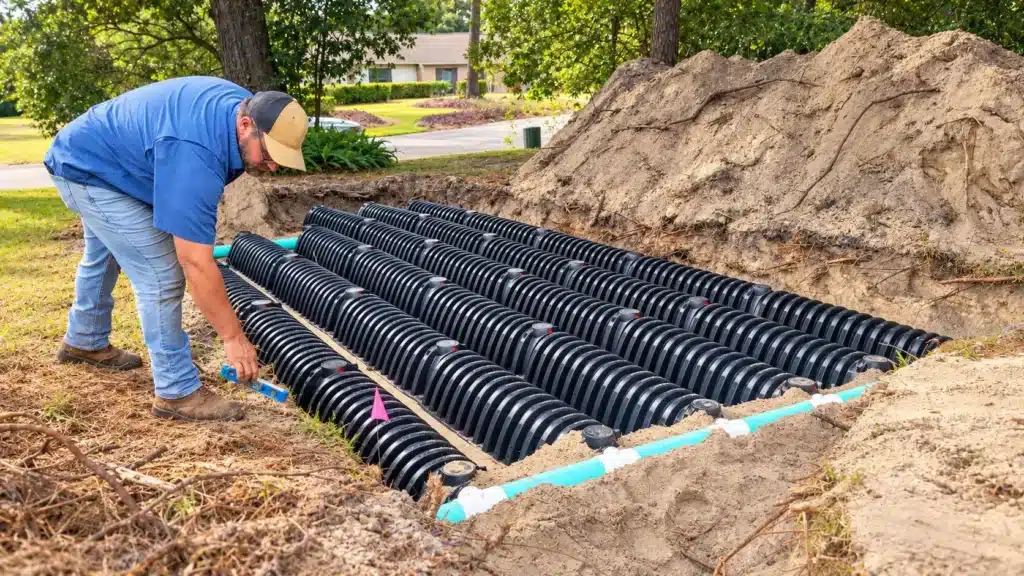
- Installation Depth: Absorption trenches are built above natural grade inside an artificially constructed mound of clean, high-permeability sand.
- Water Table Exposure: The bottom of the absorption bed remains safely separated above the wet-season high water table by at least 24 inches of unsaturated sand.
- Performance Result: Continuous aerobic biological digestion, rapid wastewater percolation, zero surface saturation, and complete elimination of sulfur gas venting.
When building new commercial structures, multi-family complexes, or residential subdivisions, site engineers must account for soil percolation rates and local environmental rules. Partnering with a licensed contractor for sitework & new construction utilities ensures your civil site utility infrastructure is installed in full compliance with municipal health codes and environmental protection standards.
External References
- Florida Department of Environmental Protection (FDEP) – Regulatory guidance on wastewater management, FOG compliance, and environmental protection standards.
- U.S. Environmental Protection Agency (EPA) – SepticSmart – Official technical guidelines for onsite wastewater treatment system operation and drainfield protection.
- Florida Department of Health – Onsite Sewage Programs – Florida state codes and technical requirements for residential and commercial septic systems.
Key Takeaways
- Summer Weather Drives Odors: Daily rainstorms raise high water tables while afternoon sun expands gas, driving hydrogen sulfide ($H_2S$) rotten egg smells out of drainfield soil.
- Biomat Clogging Causes Trapped Wastewater: Thick organic biomat layers block effluence drainage, creating stagnant underground pools that off-gas under intense summer heat.
- Plumbing Stack Venting Is Critical: Blocked roof stacks force expanding sewer gases backward through drainfield distribution boxes or indoor drain fixtures.
- Chemical Additives Do Not Work: Harsh chemical additives kill beneficial soil bacteria and ruin drainfield absorption capacity; rely on mechanical maintenance instead.
- Professional Diagnostic Solutions Exist: Hydro-jetting, video pipe inspections, effluent filters, and elevated mounded system installations permanently resolve summer drainfield issues.
Request Professional Septic and Underground Utility Solutions
If your drainfield produces rotten egg smells on warm afternoons, do not wait for raw sewage to back up into your home or commercial facility. Lapin Services brings over six decades of hands-on expertise to every job across Central Florida. Holding triple licensure as a Master Septic Contractor (SM0890812), Certified Plumbing Contractor (CFC1428594), and Underground Utility Contractor (CUC1223686), our team diagnoses and resolves complex residential, commercial, and municipal wastewater challenges. Contact our master technical specialists today by visiting our page to request a project quote or call (407) 326-3367 for 24/7 emergency dispatch.