
Most plumbing and sewer problems exist underground and inside walls, completely invisible until the damage they cause becomes impossible to ignore. For most of the history of residential and commercial plumbing, diagnosing what was happening inside a pipe meant either educated guessing based on symptoms, or digging to look. Neither approach was particularly efficient, and neither was particularly kind to a property owner’s budget or their yard.
Video pipe inspection changed that. A flexible camera fed through a pipe reveals its interior condition in real time — exactly what’s there, exactly where it is, and exactly what it looks like — without opening a wall or disturbing a single inch of ground. It is, by a significant margin, the most cost-effective first step available for any plumbing or sewer problem that can’t be resolved by a straightforward drain cleaning, and for any situation where the condition of underground or in-wall pipes needs to be known before a decision is made.
What Video Pipe Inspection Actually Is
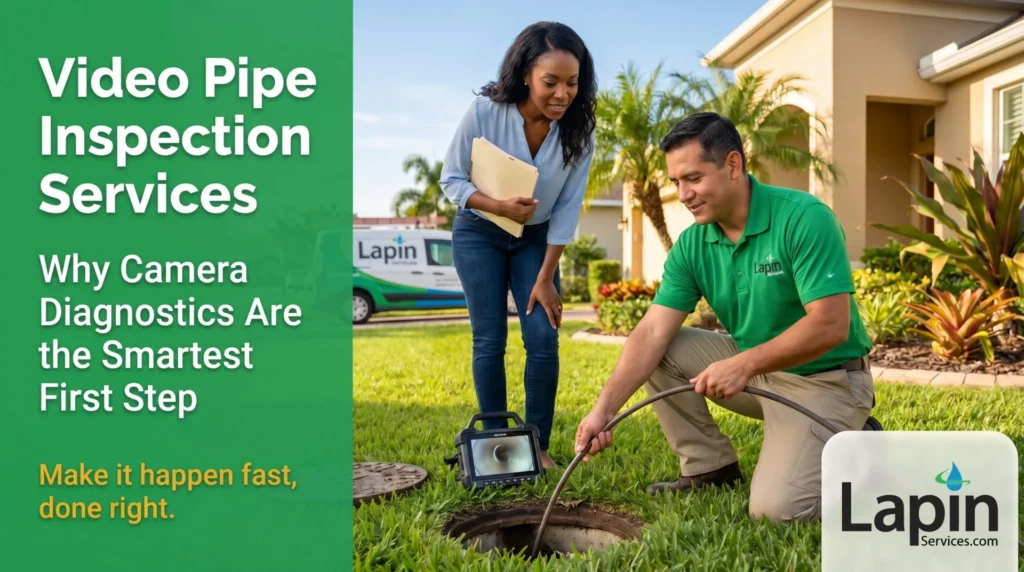
A video pipe inspection — also called a sewer camera inspection, pipe camera inspection, or sewer scope — uses a waterproof camera mounted on a flexible cable to travel through a pipe and transmit live footage to a monitor at the surface. The camera is introduced through an existing access point: a cleanout fitting, a toilet, a floor drain, or in some cases a direct access point in the line itself. As the technician feeds the cable through the pipe, the camera sends real-time images and records the footage for documentation and reference.
Modern inspection cameras are equipped with lighting sufficient to illuminate the interior of dark pipes at working distance, and they transmit high-resolution footage that shows pipe condition in meaningful detail — cracks, joint separations, root intrusions, scale buildup, corrosion, debris accumulations, offset sections, and any foreign objects inside the line. Many systems also carry a locator transmitter in the camera head that allows the technician to pinpoint the camera’s location from the surface, so when a problem is identified, its precise position and depth underground can be marked without excavation.
The result is a documented, visual record of what’s happening inside a pipe that no other diagnostic method can provide without removing material or opening the ground.
Why It’s the Right First Step — Not the Last Resort
The most common mistake property owners make with pipe problems is reaching for video inspection only after multiple service attempts have failed to resolve the issue, or after a plumber has already recommended an expensive repair and the owner wants a second opinion. By that point, the camera inspection is doing valuable work, but it’s working against a backdrop of money already spent and time already lost.
The smarter sequence — and the one that consistently saves money over the course of a plumbing problem — is to scope the line before any significant repair decision is made. A sewer camera inspection typically costs a fraction of what a repair costs. It confirms whether a repair is actually needed, what kind of repair is appropriate, and exactly where in the line the work needs to happen. That information prevents the two most expensive outcomes in residential and commercial plumbing:
- Over-repair, where a line is replaced that only needed spot treatment
- Under-repair, where a problem is patched at one point while the actual failure is somewhere else
Consider the common scenario of a recurring drain backup. A plumber clears the line with a snake or hydro jetting, the drain runs freely for a few weeks, and then the backup returns. That cycle can repeat itself for years — each service call resolves the symptom but not the cause, because nobody has looked at what’s actually happening inside the pipe. A camera inspection after the first recurrence ends that cycle. If the cause is root intrusion at a cracked joint, the footage shows it. If the cause is a partial pipe collapse that a snake temporarily displaces, the footage shows it. If the cause is simply grease buildup that needs more aggressive treatment, the footage shows that too — and it rules out the more expensive explanations that would have otherwise been pursued.
The same logic applies to any situation where the condition of a pipe is uncertain. Uncertainty in plumbing is expensive. Information is low-quality by comparison.
The Real Estate Context: Why Homebuyers Need This
The Central Florida real estate market moves quickly, and the inspection period in a purchase transaction is rarely long enough for buyers to feel fully confident about everything they’re agreeing to. One of the most consistently underinspected components of a residential property is the main sewer line or septic lateral — the underground pipe that carries all wastewater from the home to either the municipal sewer main or the septic tank.
A standard home inspection covers visible, accessible components. The sewer lateral running three to six feet underground from the house to the street or to a septic tank is not visible or accessible without a camera. A general home inspector will not scope it. Yet it’s the component that, if it fails, produces one of the most disruptive and expensive repair scenarios a new homeowner can face — particularly in older Central Florida homes where cast iron drain lines, root intrusion from mature trees, or Orangeburg pipe in the lateral are real possibilities.
A sewer scope inspection before closing is a straightforward way to remove that uncertainty from the transaction. The camera goes in through a cleanout or toilet, travels the full length of the lateral, and produces footage that shows the pipe’s condition from one end to the other. If the line is in good shape, the buyer proceeds with one less unknown. If the footage reveals a cracked section, significant root intrusion, or a pipe material approaching end of life, the buyer has documented evidence to negotiate a repair credit, request a seller repair before closing, or make an informed decision about whether to proceed. That’s real, actionable information that no amount of visual inspection from the surface can provide.
Real estate agents in the Orlando market increasingly recommend sewer scope inspections to their buyers as a standard part of the due diligence process, particularly for homes built before 1990 or properties with mature trees in the yard or along the pipe path. It’s a small upfront cost against a very large potential liability.
What a Camera Inspection Reveals
The scope of what video pipe inspection can identify is broad enough to cover the most common causes of sewer and drain problems in Central Florida homes and commercial properties. Root intrusion — the single most common cause of sewer line damage in this region — is immediately visible as roots penetrating the pipe interior through joints or cracks, ranging from hair-thin tendrils at early stages to dense root masses that have narrowed the pipe to a fraction of its designed capacity. Cracks and fractures in the pipe wall show as breaks in the otherwise smooth interior surface, and offset joints — where ground movement has shifted pipe sections out of alignment — are visible as misaligned edges that disrupt flow and collect debris.
Corrosion and scale buildup inside older iron or steel pipes shows as rough, narrowed interior surfaces that reduce flow capacity even when there’s no structural failure. Debris accumulations — grease, mineral deposits, construction debris in newer pipes — are visible as obstructions that a camera can approach and characterize before any cleaning attempt begins. And collapsed sections, where a pipe has physically deformed or caved inward, show as the abrupt end of navigable pipe that they are.
What the camera also shows, importantly, is what isn’t there. A homeowner who has been told they need a full sewer line replacement because of a recurring backup may discover on camera that the actual problem is confined to a single cracked joint three feet outside the foundation — a spot repair, not a full replacement. That finding alone can be worth thousands of dollars in unnecessary repair costs avoided.
Commercial Applications: More Complex, More Consequential
While homebuyers and residential property owners are the most common customers for video pipe inspection, the value of camera diagnostics scales up meaningfully in commercial settings where the pipe systems are larger, the consequences of failure are more disruptive, and the decisions that follow an inspection carry larger dollar values.
Commercial properties — office buildings, retail centers, restaurants, hotels, multi-family complexes — have sewer and drainage infrastructure that handles significantly higher flow volumes than residential plumbing and is subject to the accumulation of materials that residential systems aren’t. Grease in restaurant drain lines, high-mineral-content water in hotel laundry systems, and the sheer volume throughput in multi-family housing all accelerate the conditions that lead to pipe degradation. CCTV sewer inspections in commercial settings use cameras suited to larger-diameter pipes and can cover the full network of drain lines in a building, generating footage that facilities managers use to plan maintenance, prioritize repairs, and document system condition for insurance and property transaction purposes.
For property managers overseeing multiple assets, periodic video inspection of the drain and sewer infrastructure across a portfolio is the kind of proactive maintenance documentation that prevents the emergency repair calls that are both the most expensive and most operationally disruptive version of the same problem. A scheduled inspection every few years costs a defined amount and produces documented findings. An emergency excavation because a collapsed sewer line wasn’t caught in time costs multiples of that and happens at the worst possible moment.
What to Expect From a Video Pipe Inspection Service
A professional video pipe inspection visit at a residential property typically takes one to two hours from setup to completion and camera removal. The technician introduces the camera through the most accessible entry point — usually a cleanout fitting near the foundation if one is accessible, or through a ground-floor toilet if not — and works the camera through the line at a pace that allows the footage to document conditions thoroughly rather than rushing past areas of interest.
When the inspection is complete, the homeowner should receive a copy of the recorded footage and a verbal or written summary of findings. Some providers offer digital delivery of the footage, which is particularly valuable if findings will be used in a real estate negotiation or a conversation with a second contractor about repair scope. If a locator transmitter was used to mark problem areas, those positions should be marked or documented in relation to surface features so they can be found again when repair work begins.
At Lapin Services, video pipe inspection is the standard starting point for any sewer line or drain problem where the cause isn’t immediately apparent from surface symptoms. It takes the guesswork out of the diagnosis entirely, and it gives both the homeowner and the technician the same visual reference point for understanding what needs to happen next.
Frequently Asked Questions
What does a video pipe inspection show?
A camera inspection shows the interior condition of a pipe in real time — including root intrusion, cracks, joint offsets, pipe collapse, corrosion, scale buildup, grease accumulation, and any foreign material inside the line. It also shows sections of pipe that are in good condition, which is equally useful for ruling out problems that symptoms might otherwise suggest.
How much does a sewer camera inspection cost in Orlando?
Video pipe inspection for a standard residential sewer line in Central Florida typically runs between $150 and $350 depending on the scope of the inspection, the length of line being evaluated, and whether the service is standalone or performed in conjunction with other work. It is consistently one of the most cost-efficient steps available in a plumbing diagnostic process given what it reveals.
Do I need a sewer camera inspection when buying a home?
For any home built before 1990, any home with mature trees in the yard or near the sewer line path, or any property where the sewer lateral condition isn’t documented, a pre-purchase sewer scope inspection is a sound investment. It reveals conditions that a standard home inspection cannot assess and gives buyers documented information they can act on before the transaction closes.
Can a camera inspection be used for drain lines inside the house, or only for the main sewer line?
Video inspection can be used for both. The main sewer lateral is the most common application, but camera inspections of interior drain lines, under-slab plumbing, and specific branch lines are all performed when symptoms point to a localized problem inside the structure rather than in the main line.
How far can a pipe camera travel?
Modern sewer cameras on professional cable systems can travel 200 feet or more through a pipe, which covers the full length of most residential sewer laterals and a significant portion of commercial drain networks. For longer runs, access through multiple cleanout points may be used to inspect the full system in segments.
What happens after the camera inspection finds a problem?
The inspection footage gives the technician and the homeowner a clear, shared understanding of what the problem is and exactly where it is. From that baseline, the appropriate repair recommendation — spot repair, trenchless lining, hydro jetting, full replacement — can be made with confidence rather than estimated based on symptoms. The footage also serves as documentation if the repair requires permits or involves insurance.
See What’s Inside Before Deciding What to Do About It
The principle behind video pipe inspection is straightforward: information before action produces better outcomes than action based on guesswork. For a homeowner dealing with a persistent drain problem, a buyer evaluating a property with an unknown sewer system, or a property manager trying to stay ahead of infrastructure failures across a portfolio, the camera is the tool that makes every subsequent decision better informed and more cost-effective.
If you’re dealing with a plumbing or sewer situation in Orlando or Central Florida where the cause isn’t clear, or if you’re purchasing a property and want a complete picture of what the underground infrastructure looks like before you close, Lapin Services provides professional video pipe inspection with full camera documentation and clear findings summaries.
Call Lapin Services at (407) 326-3367 or visit lapinservices.com to schedule your pipe inspection.