
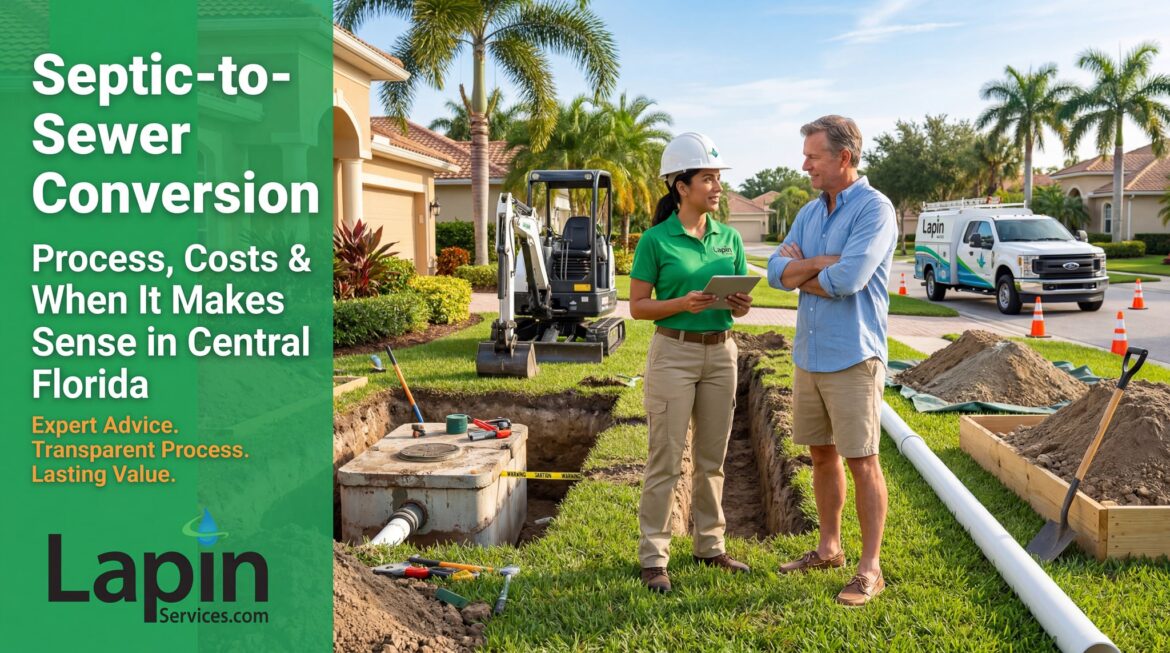
Municipal sewer service has been expanding steadily across Central Florida for years. As Orange, Seminole, Osceola, and Lake counties continue to grow and utility infrastructure reaches neighborhoods that have historically relied on private septic systems, more homeowners are facing a decision they’ve never had to consider before: whether to connect to the city sewer or stay on septic.
For others, the decision isn’t optional — a failing septic system, a property sale requirement, or a mandatory connection notice from the county utility authority forces the question. Either way, the homeowners who navigate this process most smoothly are the ones who understand what’s actually involved before they start making calls.
This guide covers the full picture: what triggers a conversion, how the process works from permit to final connection, what it costs, what happens to the old septic system, and how to evaluate whether conversion makes sense for your specific situation.
What Triggers a Septic-to-Sewer Conversion
The circumstances that bring homeowners to this decision fall into a few distinct categories, and the category you’re in affects both your timeline and your options.
The most common trigger in Central Florida right now is municipal sewer expansion. When a county utility authority extends a sewer main into a previously unsewered area, property owners within a defined proximity to that main are typically notified that connection is available — and in many cases, that connection will eventually be required within a specified timeframe, often five to ten years from the date the main becomes available. Some municipalities issue mandatory connection orders on a shorter timeline, particularly in areas with documented water quality concerns from septic system density. If you’ve received a notice like this, you’re not being asked to decide whether to convert — you’re being asked to decide when, and to plan your budget accordingly.
The second trigger is a failing or end-of-life septic system. A drain field that has reached the end of its functional life, a tank that has structural damage, or a system that can no longer meet current Florida Department of Health standards for OSTDS — onsite sewage treatment and disposal systems — requires either significant repair and replacement investment or a conversion to municipal sewer if that service is available at the property. For homeowners facing a full drain field replacement costing several thousand dollars, the presence of a municipal sewer main nearby changes the calculation. The conversion might cost more upfront, but it eliminates future maintenance liability entirely.
The third is a real estate transaction. Buyers, lenders, and title companies increasingly scrutinize septic systems as part of the purchase process. An aging system in a neighborhood where sewer service is available — and where a mandatory connection order may be forthcoming — can complicate a sale. Some sellers choose to convert before listing to remove that variable from negotiations.
How the Conversion Process Works
A septic-to-sewer conversion involves three distinct phases that have to happen in the right sequence: permitting, physical connection, and septic system decommissioning. Each phase involves different parties, different inspections, and different costs, and understanding the sequence prevents the kind of missteps that add time and expense to what should be a straightforward project.
The process begins with confirming that municipal sewer service is actually available and accessible at your property. Available means a sewer main runs within a distance that makes connection feasible — in most Central Florida jurisdictions, that means within a specified footage of the property boundary, typically measured to the nearest available connection point on the main. Your county utility authority can confirm availability and provide the connection requirements specific to your address, including whether a tap fee is required to establish the new service account.
Once availability is confirmed, the permitting phase begins. A septic-to-sewer conversion requires permits from multiple parties: the county building department for the plumbing work connecting the home’s drain lines to the new lateral, the county utility authority for the actual connection to the sewer main, and in many cases the Florida Department of Health for the abandonment of the existing septic system. Working with a licensed contractor who handles permit applications as part of the project is significantly more efficient than attempting to navigate those applications independently — the requirements vary by county, the forms reference each other, and the inspection sequence matters for getting everything signed off in the right order.
The physical work involves installing a new sewer lateral — the underground pipe that runs from the home to the municipal main — and connecting the home’s existing drain lines to it. Depending on the distance from the house to the main, the depth of the connection point, and what existing underground utilities are in the path, this work can range from a straightforward single-day installation to a more involved excavation project. The contractor needs to be a licensed plumbing contractor and, where the work involves underground utilities at depth, a licensed underground utilities contractor. Florida’s licensing structure for this work is specific, and confirming your contractor holds the right licenses before the project starts protects you from problems at inspection.
Once the lateral is installed and the connection to the municipal main is made and inspected, the home’s plumbing is redirected to the new sewer line and the existing septic system is taken out of service. This isn’t as simple as just stopping use of the tank — Florida law requires formal abandonment of any decommissioned septic system, and that process has its own permit and inspection requirements.
What Happens to the Old Septic System
Septic tank abandonment in Florida is governed by Florida Department of Health regulations under the OSTDS program, and it cannot be skipped or deferred simply because the system is no longer in active use. A tank left in the ground without proper decommissioning is a liability — structurally, legally, and from a property records standpoint.
Proper abandonment begins with pumping the tank completely empty of all waste and sludge. Once emptied, the tank must be either removed from the ground entirely or rendered inert in place, depending on the tank’s construction material, its condition, and the preference of the property owner. Concrete tanks are typically abandoned in place — the structural integrity makes removal more labor-intensive than necessary in most cases. The abandonment process involves pumping the tank, removing or collapsing the baffles, filling the tank with clean sand, gravel, or concrete slurry to prevent future collapse, and having the work permitted and inspected by the county health department.
The permit for septic abandonment is separate from the building permit for the plumbing connection, and it must be closed out with a passing inspection before the project is fully complete from a regulatory standpoint. Some homeowners are surprised to learn this step is required — the assumption that “we just stop using it” is understandable but not how Florida’s regulatory framework works. A contractor who handles the full project scope — connection and abandonment — manages both permits and both inspections as a coordinated project rather than leaving the homeowner to track multiple open permits independently.
What a Septic-to-Sewer Conversion Costs
Cost is the question that drives most of the decision-making here, and it deserves a direct answer even though the honest answer involves a real range. A straightforward conversion for a single-family home in Central Florida — moderate distance from the main, accessible yard, no significant underground conflicts — typically runs between $3,500 and $8,000 for the full project including lateral installation, connection, and septic abandonment. Projects with greater distance to the main, difficult soil or access conditions, deep connection requirements, or additional permitting complexity will exceed that range.
The cost components that most significantly affect the total are the distance from the house to the sewer main connection point, the depth of the lateral — deeper connections require more excavation — the county tap fee if one applies, and whether the old septic tank is being removed or abandoned in place. Removal adds cost that in-place abandonment doesn’t, but it frees up yard space and eliminates any future concern about settlement over the old tank location.
There’s also the ongoing cost shift to account for. After conversion, you’ll pay a monthly sewer utility bill that you weren’t paying before — typically ranging from $30 to $80 per month depending on the municipality and usage tier. That’s a new recurring expense in exchange for eliminating all future septic maintenance, pumping, inspection, and repair costs. For a well-maintained septic system on a normal schedule, the crossover point where the cumulative utility payments equal what septic maintenance would have cost over the same period is usually somewhere in the ten-to-fifteen-year range. For a system facing significant near-term repair costs, conversion can become the more economical choice much sooner.
When Conversion Makes Sense — and When It Doesn’t
For homeowners with a healthy, well-maintained septic system in an area where sewer connection is available but not yet mandatory, the financial case for voluntary conversion is not always clear-cut. If your drain field is young, your tank has been pumped consistently, and your system is showing no signs of stress, the investment in conversion buys you a reduction in future maintenance responsibility but not necessarily an immediate return. The calculation changes if you’re planning to sell within a few years — buyers in sewer-served areas increasingly prefer a sewer connection — or if mandatory connection is foreseeable within your ownership horizon.
For homeowners facing a significant septic repair or replacement, the math shifts substantially. If your drain field needs replacement and municipal sewer is available at the property, comparing the cost of a new drain field against the cost of conversion is a legitimate exercise. Drain field replacement in Central Florida runs in a similar cost range to sewer conversion in many cases, and it still leaves you with a septic system to maintain going forward. Conversion makes that the last major wastewater infrastructure investment you make at that property.
For homeowners who have received a mandatory connection notice, the decision is effectively made — the only variables are timing and contractor selection. Getting the project done earlier in the mandatory window is almost always better than waiting: it avoids last-minute scheduling pressure during the compliance deadline period, and it gives you time to properly plan the project rather than rushing it.
Frequently Asked Questions
How do I know if city sewer is available at my property in Central Florida?
Contact your county utility authority directly — Orange County Utilities, Seminole County Utilities, Osceola County Utilities, or the relevant municipal utility for your address. They can confirm whether a sewer main is within connection distance of your property and provide current connection requirements and fees. A licensed contractor familiar with Central Florida utility infrastructure can also confirm this as part of a project consultation.
Is septic-to-sewer conversion required in Orange County?
Connection is required when municipal sewer becomes available within a specified distance of the property and the county issues a mandatory connection order. Not all properties in Orange County have received such orders, and the timing varies based on when infrastructure expansion reaches a given area. If you’ve received a notice, the letter will specify the compliance deadline.
What permits are needed for a septic-to-sewer conversion in Florida?
Most conversions require a plumbing permit from the county building department, a utility connection permit from the municipal sewer authority, and a septic system abandonment permit from the Florida Department of Health through the county environmental health office. A licensed contractor handles the permit applications as part of the project.
Can I keep my septic tank after connecting to city sewer?
Not in active use — once connected to municipal sewer, the septic system must be taken out of service. Florida regulations require formal abandonment of decommissioned septic systems, which involves emptying, filling, and permitting the tank. Simply disconnecting and leaving the tank in the ground without proper abandonment is not compliant with Florida DOH requirements.
How long does a septic-to-sewer conversion take?
For a typical single-family residential project, the permitting process is usually the longest phase — allow two to four weeks for permit approval depending on current county backlogs. The physical installation work typically takes one to two days for a straightforward project. More complex projects with greater lateral distance or difficult access conditions take longer. Total timeline from permit application to final inspection is commonly four to six weeks.
Does converting from septic to sewer increase my home’s value?
In most Central Florida markets, yes — particularly in areas where sewer connection is the norm or where buyers perceive ongoing septic maintenance as a concern. The impact varies by neighborhood and price point, but a home with a sewer connection is generally more straightforward to sell and finance than one with a septic system in the same market area.
Making the Right Decision for Your Property
The septic-to-sewer conversion decision involves enough variables — system condition, proximity to the main, project cost, future maintenance savings, and market considerations — that there isn’t a single right answer for every homeowner. What there is, for every homeowner facing this question, is a right process: get accurate information about availability and cost, understand the full project scope including abandonment requirements, and work with a licensed contractor who handles the permits, the installation, and the decommissioning as a complete project rather than as separate engagements.
Lapin Services handles septic-to-sewer conversions across Orlando and Central Florida as a fully integrated project — lateral installation, municipal connection, and Florida DOH-compliant septic system abandonment under one contractor, one project timeline, and one permit coordination process. We hold the Underground Utilities Contractor and Plumbing Contractor licenses the work requires, and we’re familiar with the specific requirements across Orange, Seminole, Osceola, and Lake counties.
Contact Lapin Services at (407) 326-3367 or visit lapinservices.com to discuss your conversion project and get a project-specific quote.