
What Your Sewer Line Does — and Why It Matters
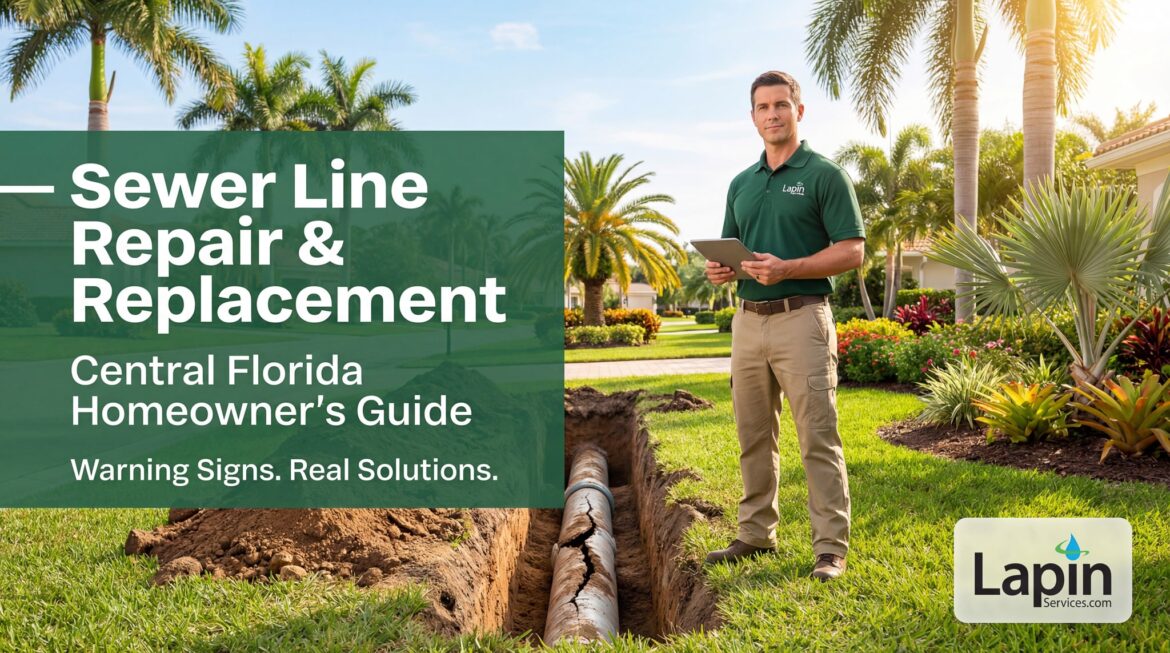
Your sewer line is the main artery of your home’s drainage system. Every fixture — sinks, toilets, showers, washing machine — connects to a single main line that runs underground from your home to either the municipal sewer system or, in many parts of Central Florida, a septic tank. When that line is blocked, cracked, or infiltrated by roots, nothing downstream functions properly. The impact isn’t limited to one fixture. It affects the entire property.
The Warning Signs You Shouldn’t Ignore
Sewer line problems rarely appear without warning. The signs tend to start subtle and build over time, which is exactly why so many homeowners dismiss them longer than they should.
The most telling early sign is multiple slow drains throughout the house. A single slow drain usually points to a localized clog in that fixture’s branch line. When two or three drains are moving slowly at the same time — especially in different parts of the house — the problem is almost certainly in the main sewer line. Gurgling or bubbling sounds from toilets and drains after using other fixtures are closely related: they indicate that air is being trapped in the system because flow is restricted somewhere downstream.
Sewage odors are another signal that deserves immediate attention. A properly functioning sewer system is airtight. If you’re detecting odors near floor drains, in a crawlspace, or outside near the foundation or yard, sewer gas is escaping somewhere it shouldn’t — through a crack, a failed joint, or a break in the line.
The most urgent warning sign is sewage backup in the lowest drains of the home. When waste comes up through a ground-floor toilet, shower drain, or floor drain — particularly after using an upstairs fixture — the main sewer line is blocked or failing. Stop using water throughout the home and call a plumber immediately. This one doesn’t wait.
Outside the home, watch for these additional warning signs:
- Unexplained wet or sunken areas in the yard along the path where your sewer line runs
- Unusually green or lush strips of grass — the result of raw sewage acting as fertilizer underground
- Foundation settling or structural cracking caused by soil erosion from a slow sewer leak
Why Sewer Lines Fail in Central Florida
Several factors are particularly relevant to homeowners in Orange, Seminole, Osceola, and Lake counties.
Tree root intrusion is the leading cause of sewer line damage in this region. Central Florida’s warm climate and consistent rainfall create ideal conditions for aggressive root systems, and roots are naturally drawn to the moisture and nutrients inside a sewer line. Once roots find their way into a joint or crack, they expand over seasons until they cause blockages or structural failure. You don’t need a large tree directly overhead — roots travel significant distances.
Aging pipe materials are the second major factor. Homes built before 1980 in the Orlando area were frequently plumbed with cast iron or Orangeburg pipe. Cast iron corrodes over decades. Orangeburg — a tar-and-paper composite used through the 1970s — absorbs moisture over time and eventually softens and collapses from its own weight. If your home was built in that era and has never had a sewer inspection, the pipe material alone warrants professional evaluation.
Florida’s high water table compounds both problems. In low-lying areas, hydrostatic pressure bears against older pipes and, in some cases, allows groundwater to infiltrate cracked lines — a condition that overloads the system and speeds up deterioration. Seasonal ground movement from heavy rain cycles and drought also causes soil shifts that can separate pipe joints or crack previously stable sections.
The Right Repair Starts With a Camera Inspection
Before any repair recommendation is made, a licensed plumber should run a camera through the line. A sewer camera inspection identifies the precise location and nature of the damage — whether that’s a root mass, a cracked joint, a collapsed section, or widespread pipe deterioration along a longer stretch.
This matters more than most homeowners realize. Without a camera, the extent of damage is unknown, and repair scope is guesswork. A proper diagnosis prevents over-repair — replacing a line that only needs spot treatment — and under-repair — patching a line that’s actually failing in multiple places. Camera footage also provides documentation that’s valuable for home sales, insurance conversations, or any dispute about repair scope.
At Lapin Services, a camera inspection is the standard starting point for any sewer line evaluation. It takes the guesswork out of the diagnosis entirely.
Sewer Line Repair and Replacement Options
Not every sewer line problem requires full replacement, and the right solution depends on what the camera reveals.
- Hydro jetting — For blockages caused by grease buildup, debris accumulation, or minor root intrusion where the pipe structure is still sound. High-pressure water clears the line thoroughly and restores full flow without excavation.
- Spot repair — When damage is confined to a short section — a cracked joint, a single point of root penetration, a small collapse. This addresses the problem without disturbing the rest of the line and may require only limited digging.
- Trenchless pipe lining — A resin-saturated liner is inserted into the damaged pipe and cured in place, forming a new seamless pipe within the old one — without excavating along the line’s full length. Particularly valuable in established Central Florida neighborhoods where open trenching would tear through landscaping, driveways, or hardscaping.
- Full replacement with trenchless pipe bursting — When a line has failed along a significant portion of its length — from collapse, severe root intrusion, or material failure like Orangeburg pipe. New pipe is pulled through the old line while fracturing and displacing the damaged material, allowing full replacement with minimal excavation.
Cost varies significantly based on repair method, pipe depth, line length, and access conditions. What doesn’t vary is the relationship between delay and expense: a blockage left unaddressed becomes a crack, a crack becomes a collapse, and a collapse that damages surrounding soil is exponentially more expensive than any earlier intervention point.
Frequently Asked Questions
How do I know if I have a sewer line problem or just a clogged drain?
A single slow or clogged drain is usually isolated to that fixture’s branch line. When multiple drains throughout the home are slow, backing up, or gurgling simultaneously, the main sewer line is almost always involved.
Can tree roots really destroy a sewer line?
Yes — and it happens regularly in Central Florida. Roots enter through joints or existing cracks and expand over years, eventually causing blockages and structural damage. Trees don’t need to be directly above the line to pose a threat.
Is trenchless sewer repair available in Orlando?
Yes. Both pipe lining and pipe bursting are widely available in the Orlando area and are often the preferred option in established neighborhoods where full excavation would cause significant disruption.
Does homeowners insurance cover sewer line repair?
Standard policies typically don’t cover sewer line repair, as it’s generally treated as a maintenance issue. Some insurers offer sewer line coverage as an add-on endorsement. Review your policy or speak with your agent to understand what protection you have.
How often should I have my sewer line inspected?
For homes with mature trees near the sewer line, older pipe materials, or a history of recurring clogs, a camera inspection every three to five years is a reasonable preventive step. Before purchasing any older home, a sewer inspection should be treated as non-negotiable.
The Right Time to Act Is Before It Gets Worse
Sewer line problems don’t resolve on their own. The warning signs that seem manageable today are the early stages of a problem that will eventually demand attention — the only question is how much damage accumulates in the meantime.
If you’re seeing any of the signs described here, or if your Central Florida home has never had a professional sewer inspection, the team at Lapin Services is ready to help. We serve Orlando and the surrounding region with camera inspections, hydro jetting, trenchless repair, and full sewer line replacement — with honest diagnostics and no unnecessary upsells.
Call Lapin Services to schedule your sewer line inspection today.

Related Articles
-

Septic-to-Sewer Conversion in Central Florida: Process, Costs, and When It Makes Sense
-
Lift Station Repair and Maintenance in Central Florida: What Property Owners Need to Know
-

How Much Does Grease Trap Cleaning Cost in Orlando? A Guide for Restaurant Owners
-

How Florida’s Rainy Season Affects Your and Plumbing