
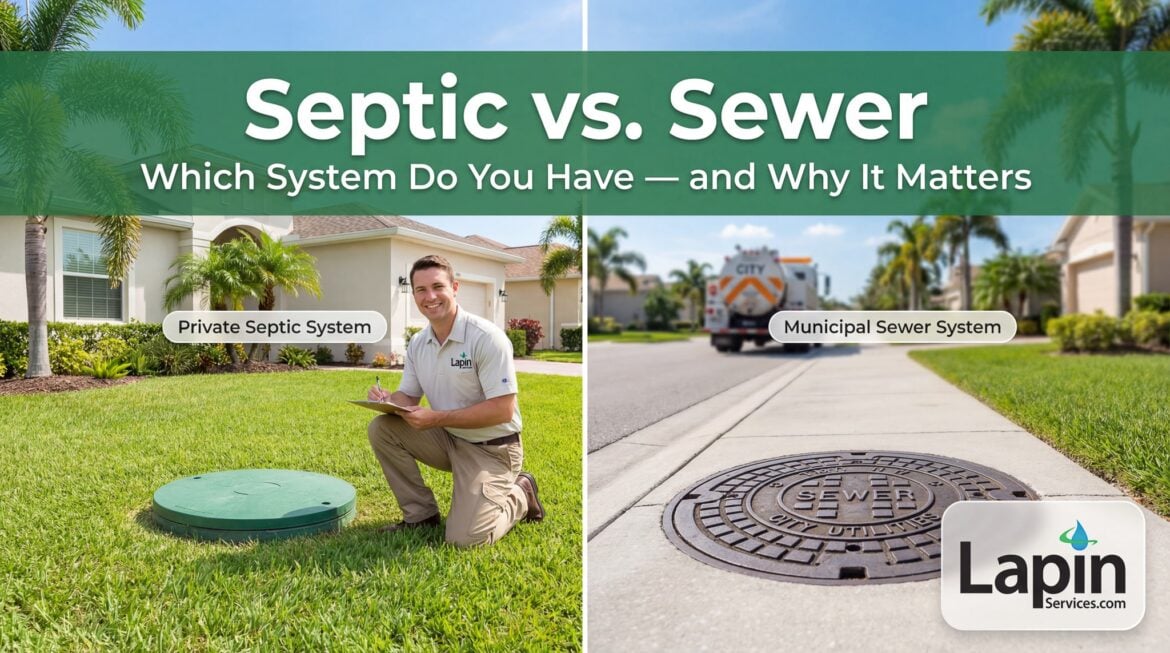
If you’ve ever moved from a home connected to city sewer into a house with a septic system — or vice versa — you already know that the two are fundamentally different in ways that affect how you manage your property. If you’ve never had to think about it, you may not know which system your home uses at all. That’s more common than you’d think, particularly in Central Florida, where municipal sewer coverage and private septic systems exist side by side across the same counties and sometimes the same neighborhoods.
Knowing which system you have, how it works, and what it requires isn’t optional homeowner knowledge. It directly affects your maintenance responsibilities, your costs, your property value, and what happens when something goes wrong.
The Fundamental Difference
Both systems exist to do the same thing: safely remove wastewater from your home. Where they differ is in how and where that wastewater is treated.
A municipal sewer system is a shared public infrastructure. When you flush a toilet or run a sink in a sewer-connected home, wastewater travels through your home’s drain lines, exits through a main sewer line underground, and flows into a network of pipes maintained by your city or county. Eventually that wastewater reaches a centralized treatment facility, where it’s processed on a large scale before being discharged or reused. As a homeowner connected to city sewer, you pay a monthly utility fee for this service. Your primary responsibility ends at the point where your property’s plumbing connects to the municipal system — typically at the property line.
A septic system is a private, on-site wastewater treatment system. There’s no connection to a public network. Instead, wastewater from your home travels to a septic tank buried in your yard, where it begins a treatment process contained entirely on your property. The homeowner owns the system, maintains it, and bears the full cost when something needs repair or replacement. In exchange, there’s no monthly sewer utility bill — but the maintenance responsibilities are real and ongoing.
How a Septic System Actually Works
Understanding how a septic system functions makes it much easier to understand why certain habits matter and what can go wrong when the system is neglected.
When wastewater leaves your home, it flows into the septic tank — a watertight underground container, typically made of concrete, fiberglass, or polyethylene, sized based on the number of bedrooms in the home. Inside the tank, the waste naturally separates into three layers:
- Sludge — heavy solids that sink to the bottom
- Scum — fats, oils, and lighter materials that float to the top
- Effluent — the relatively clear liquid in the middle that moves forward in the treatment process
That effluent flows out of the tank through an outlet baffle and into the drain field, also called a leach field — a network of perforated pipes buried in gravel-filled trenches beneath the yard. As effluent seeps out of those pipes and into the surrounding soil, the soil itself filters and treats it, removing pathogens and nutrients before the water eventually re-enters the groundwater supply. The soil is the final treatment stage, which is why soil type and drain field condition matter so much to a system’s long-term performance.
Meanwhile, back in the tank, beneficial bacteria work continuously to break down the solids in the sludge layer. They don’t eliminate it entirely — which is why periodic pumping is necessary — but they reduce the rate at which sludge accumulates and keep the system functioning between service intervals. This bacterial ecosystem is one of the reasons that what you put down your drains matters so much when you’re on septic. Anything that kills or disrupts those bacteria — harsh chemicals, antibacterial products in large quantities, medications — undermines the biological process the system depends on.
Why So Many Central Florida Homes Have Septic Systems
Florida has one of the highest concentrations of septic systems in the country, and Central Florida is no exception. The Orlando metropolitan area grew rapidly through the mid-to-late twentieth century, and much of that development happened in areas where extending municipal sewer infrastructure wasn’t economically viable. Subdivisions were built with individual septic systems because that was the practical solution at the time, and many of those systems are still in service today.
The result is a patchwork of coverage across Orange, Seminole, Osceola, and Lake counties where a neighborhood served by city sewer can sit adjacent to one that’s entirely on septic. Even within a single subdivision, you can sometimes find both systems depending on when different phases were built and what utility infrastructure was available at the time.
This is why “I’m in the suburbs, so I must be on city sewer” is a genuinely unreliable assumption in this region. Property age, location, and the specific development history of your neighborhood all factor in. If you’re not certain which system you have, it’s worth confirming.
How to Find Out Which System Your Home Has
The simplest way is to check your monthly utility bills. If you’re paying a wastewater or sewer charge to your city or county utility, you’re connected to municipal sewer. If you don’t see that charge, there’s a good chance you’re on septic — though some municipalities bill for sewer differently, so it’s worth verifying.
Your county property appraiser’s website is another reliable resource. In Orange, Seminole, Osceola, and Lake counties, property records often include utility and infrastructure details, including whether the home is connected to public sewer or relies on a private septic system. You can also call your local utility provider directly and ask — they can confirm coverage for your address in minutes.
If you’ve recently purchased a home and aren’t sure what the inspection or closing documents indicated, pull those records. A home with a septic system should have had a septic inspection as part of the transaction, and that documentation will confirm the system’s existence, size, and condition at the time of sale.
What Septic Ownership Actually Means Day to Day
For most homeowners, being on a septic system doesn’t require significant day-to-day attention. The system runs quietly underground and handles normal household wastewater without any active management on your part. But there are real differences in responsibility compared to a sewer-connected home that are worth understanding clearly.
The most important is routine pumping. Sludge accumulates in the tank over time regardless of how well you maintain the system, and it needs to be pumped out by a licensed professional — typically every three to five years for most Florida households, though that interval depends on tank size, household size, and usage patterns. Skipping pump cycles doesn’t make the sludge disappear. It makes the sludge layer grow until it crowds out the effluent layer and starts pushing incompletely treated waste into the drain field, which is where serious, expensive damage begins.
Beyond pumping, septic ownership means being intentional about what goes down your drains — avoiding the materials that accumulate in the tank or disrupt its biology — and protecting the drain field from physical damage caused by vehicle traffic, landscaping, or surface water drainage directed toward it. None of this is complicated, but it does require awareness that sewer-connected homeowners simply don’t need to carry.
The other meaningful difference is financial exposure. When a sewer line fails on a municipal system, the city or county handles the infrastructure on their side of the connection. When a septic system fails, the homeowner owns that problem entirely. A drain field replacement in Central Florida is a significant investment. A full system replacement is more significant still. Consistent maintenance isn’t just good practice — it’s the most reliable form of cost protection available.
Sewer-Connected Homes: What Homeowners Are Still Responsible For
Being on city sewer doesn’t eliminate plumbing responsibility — it shifts where that responsibility begins and ends. The municipal system handles wastewater once it reaches the public main, but the sewer lateral — the underground pipe that runs from your home to that main connection — is typically the homeowner’s responsibility. When that lateral develops a root intrusion, a crack, or a blockage, the repair cost falls on you, not the city.
This is a point of genuine confusion for many homeowners. They assume that a sewer connection means any underground plumbing problem is someone else’s problem. In most jurisdictions, that’s only true past the property line or the point of connection, and sometimes not even then. Knowing where your responsibility ends — and getting a sewer lateral inspection if your home is older or surrounded by mature trees — is worthwhile regardless of how well everything seems to be working.
Frequently Asked Questions
How do I know if my Central Florida home has a septic system or a sewer connection?
Check your monthly utility bills for a wastewater or sewer charge. If there isn’t one, you’re likely on septic. You can confirm through your county property appraiser’s website or by calling your local utility provider with your address.
Can a home be switched from septic to city sewer?
Yes, when municipal sewer service is available at the property. The process involves connecting to the public main, decommissioning the septic system according to Florida Department of Health requirements, and paying any applicable connection fees. Whether it makes sense financially depends on the cost of connection versus the condition and remaining life of the existing septic system.
Does having a septic system affect property value?
Not inherently — a well-maintained septic system is a normal and accepted feature in Central Florida real estate. A system that’s aging, failing, or has deferred maintenance does affect value and can complicate sales. Buyers increasingly request septic inspections as a condition of purchase, and a system in poor condition becomes a negotiating point.
How long does a septic system last in Florida?
A properly maintained system typically lasts 25 to 40 years. The tank itself often outlasts the drain field, which can require repair or replacement sooner — particularly in areas with high water tables or heavy clay content in the soil.
Is a septic system environmentally safe?
A functioning, properly maintained septic system treats wastewater effectively before it re-enters the groundwater supply. A failing system — one with a compromised drain field or a tank that hasn’t been pumped in years — can introduce pathogens and nutrients into the surrounding soil and groundwater. This is one of the environmental arguments for consistent maintenance, particularly in Florida, where the water table is close to the surface in many areas.
What’s the biggest mistake septic owners make?
Skipping pump cycles. It’s the single most common contributor to premature drain field failure, and it’s entirely avoidable. The cost of a routine pump-out is a fraction of what drain field repair or replacement costs.
The Bottom Line
Whether you’re on septic or sewer, understanding your system is basic homeownership. For the large portion of Central Florida homeowners on private septic systems, that understanding carries real financial stakes — because the system works quietly and invisibly right up until it doesn’t, and by then the repair is rarely small.
If you’re not sure which system your home has, find out. If you know you’re on septic and you’re not current on maintenance, get current. And if you have questions about your system’s condition or what service interval makes sense for your household, the team at Lapin Services is glad to help.
Contact Lapin Services to schedule a septic inspection or service appointment anywhere in the Orlando and Central Florida area.