A lift station is the kind of infrastructure that property owners and facility managers rarely think about until it stops working. When it does stop working, the consequences are immediate and unpleasant — sewage backs up, alarms trigger, and whatever is downstream of the station is at risk of overflow. In a commercial property, a residential community, or a municipal facility, a lift station failure is not a problem that waits for business hours or a convenient moment in the maintenance schedule.
Understanding what a lift station does, what proper maintenance looks like, and what separates a capable service provider from one that shows up with a truck but not the expertise to handle what they find is knowledge that pays for itself the first time something goes wrong.
What a Lift Station Does and Where They’re Found
A lift station — also called a sewage pump station — is a system designed to move wastewater from a lower elevation to a higher one when gravity alone can’t do the job. In areas where the terrain is flat, where development sits below the level of municipal sewer mains, or where wastewater needs to travel a significant distance uphill to reach a treatment facility, lift stations are the mechanical solution that keeps flow moving through the system.
Central Florida has a high concentration of lift stations for exactly these reasons. The region’s flat topography and the scale of its development — residential communities, commercial parks, hotel corridors, mixed-use developments — mean that gravity sewer systems alone can’t serve large portions of the built environment. Lift stations fill that gap, and they exist in more places than most people realize: inside gated communities and HOA-managed neighborhoods, beneath commercial parking lots, along municipal utility corridors, and on the grounds of hotels, hospitals, schools, and large multi-family properties.
The core components of a lift station are:
- A wet well — the below-grade chamber that collects incoming wastewater
- Submersible pumps that activate when wastewater reaches a set level
- Float switches or level sensors that control pump activation
- A control panel that manages the electrical operation of the system
- Valves and piping that direct flow
- An alarm system that signals when something is operating outside normal parameters
Each of these components is a potential failure point, and each requires a service provider capable of evaluating and addressing not just the mechanical side but the electrical side as well.
The Inspection and Maintenance Requirements Property Owners Face
Lift station inspection and maintenance requirements in Florida are set at the county and municipal level, and they vary somewhat across Orange, Seminole, Osceola, and Lake counties. The general framework, however, is consistent: most lift stations serving residential communities, commercial properties, or common areas under HOA management are required to undergo monthly inspections and semi-annual cleaning at minimum.
Monthly inspections exist because lift stations are active mechanical and electrical systems operating continuously. A pump that begins running less efficiently, a float switch that’s drifting out of calibration, a control panel alarm that’s been silenced rather than investigated — these are conditions that a monthly inspection catches before they become failures. A visual check of wet well levels, pump cycle timing, alarm functionality, and control panel status takes a trained technician an hour or less but provides the documentation trail that regulators and property managers both need.
Semi-annual cleaning goes deeper. The wet well accumulates grease, debris, and solids over time even when the pumps are running properly. Buildup in the wet well reduces effective capacity, puts additional strain on the pumps, and creates the conditions for accelerated component wear. Proper semi-annual cleaning uses vacuum trucks to remove accumulated waste and combination sewer jetting trucks to clear grease and debris from the wet well walls and the inlet and outlet piping. This is not work that can be performed with standard plumbing equipment — it requires the kind of specialized fleet that full-service wastewater contractors operate.
The documentation generated by these inspections and cleanings is part of what gets reviewed during county compliance checks. A lift station with a documented history of consistent maintenance is a very different regulatory conversation than one with gaps in the record.
What Lift Station Repair Actually Requires
The complexity of lift station repair is one of the things that most clearly separates capable service providers from those who are simply in adjacent businesses. Lift stations sit at the intersection of wastewater management, mechanical systems, and electrical infrastructure. A provider that can pump a wet well but can’t diagnose a control panel fault, or one that can replace a float switch but doesn’t have vacuum truck capacity for a wet well overflow, is a partial solution at best and a liability at worst.
Pump failures are the most common repair call. Submersible pumps in continuous operation wear over time, and a pump that’s laboring against buildup in the wet well wears faster than one serviced consistently. When a pump fails completely, the wet well fills until the backup pump activates — and if the backup pump is also compromised, the system loses all pumping capacity and overflow becomes a matter of hours. Pump replacement requires correctly matching the replacement unit to the station’s flow requirements, head pressure, and electrical specifications. Installing an undersized pump in a station with a high-flow demand simply shifts the failure timeline forward.
Float switches and level sensors are smaller components but disproportionately important to system function. They’re the mechanism that tells the pumps when to run. A float that sticks in the off position prevents pump activation and allows the wet well to fill unchecked. A float stuck in the on position runs the pumps continuously, burning out motors and running dry when the wet well empties. Neither failure is immediately obvious without inspection, and both can progress from a nuisance fault to a full failure between inspection intervals.
Control panel issues introduce the electrical dimension of lift station work. Modern lift station control panels are sophisticated monitoring systems with telemetry, alarm outputs, SCADA integration in some installations, and multiple interlocked safety circuits. Diagnosing a fault in that environment requires technicians with electrical qualifications and familiarity with control system logic, not just wastewater knowledge. A provider whose skill set ends at the wet well and doesn’t extend to the control panel cannot fully service a modern lift station.
Odor control is a maintenance consideration that comes up regularly in residential communities and commercial properties where a lift station sits near occupied space. Hydrogen sulfide gas generated by wastewater in the wet well can produce significant odor at the surface if ventilation is inadequate, seals are compromised, or the wet well hasn’t been cleaned on schedule. Addressing lift station odor requires diagnosing whether the source is a cleaning and maintenance issue, a structural sealing issue, or a ventilation design issue — and then treating the actual cause rather than masking the symptom.
The 24/7 Emergency Reality
A lift station doesn’t schedule its failures around business hours, and the properties that depend on one can’t wait until Monday morning for a response. Sewage overflow from a failed lift station is a health and safety event — it requires immediate containment, immediate pump-out, and immediate diagnosis of what failed and why.
A capable emergency response to a lift station failure isn’t a single technician in a service van. It’s a vacuum truck to manage wet well levels if pumping capacity is lost, a combination sewer jetting truck if the inlet line is blocked, control panel expertise to diagnose electrical faults, and pump inventory or rapid-source capability to get replacement equipment in place before the next fill cycle. Having any one of those without the others means waiting for additional resources while the problem continues.
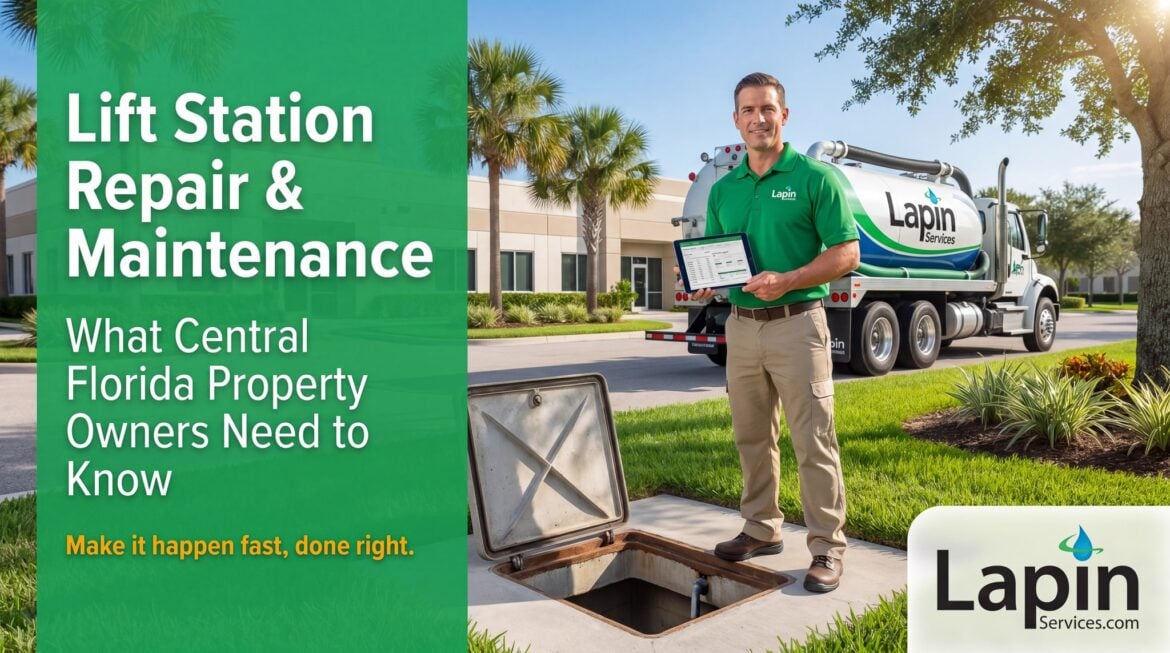
Lapin Services operates a full fleet of vacuum trucks and combination sewer jetting trucks available 24 hours a day, seven days a week, with technicians qualified in both the wastewater management and electrical control system aspects of lift station service. For properties where a lift station failure would represent a significant operational or regulatory event, that full-capability response is what the situation requires.
Why Lapin Services Is the Right Provider for Central Florida Lift Stations
The lift station service market includes companies that offer inspection as a line item alongside residential plumbing and septic pumping. It also includes utilities-focused contractors with the fleet, the certifications, and the multi-discipline expertise that complex lift station systems actually require. The difference matters enormously when something goes wrong.
Lapin Services holds licenses as an Underground Utilities Contractor, a Plumbing Contractor, and a Master Septic Contractor in Florida — a combination that covers the full scope of lift station work from the wet well to the control panel to the connecting infrastructure. Our fleet includes the vacuum trucks and jetting equipment that semi-annual cleaning and emergency response both require. And our pricing on required lift station inspections consistently beats comparable providers by 30 percent or more, which matters for HOAs and property managers who are managing maintenance costs across a community or portfolio.
For properties that need lift station installation as part of a new development or a system rehabilitation, Lapin’s underground utilities construction capability handles that work as well — from design coordination through installation and commissioning.
Frequently Asked Questions
How often does a lift station need to be inspected in Central Florida?
Most lift stations serving residential communities, HOA-managed properties, and commercial facilities in Orange, Seminole, Osceola, and Lake counties are required to undergo monthly inspections and semi-annual cleaning at minimum. Specific requirements vary by jurisdiction, and your county utility authority or the original permit documentation for the station should confirm the applicable standard.
What’s included in a proper lift station inspection?
A thorough inspection covers wet well level and condition, pump operation and cycle timing, float switch and level sensor function, control panel status and alarm system verification, valve condition, and any visible signs of wear or developing failure in mechanical components. Documentation of findings should be provided after every visit.
What causes most lift station failures?
Pump wear or failure is the most common cause, often accelerated by inadequate maintenance that allows wet well buildup to increase pump strain. Float switch malfunction, control panel faults, and blockages in the inlet line are other frequent contributors. Most failures are preceded by warning signs that consistent monthly inspection would have identified.
Can Lapin Services handle lift station emergencies after hours?
Yes. Lapin operates 24/7 emergency response with vacuum trucks and combination jetting equipment, along with technicians qualified in both wastewater management and control system diagnosis. A lift station emergency requiring immediate wet well management and pump diagnosis is within our standard emergency response capability.
How does lift station service pricing work, and why does Lapin beat competitors?
Lift station inspection pricing is typically quoted per visit or on a monthly contract basis. Lapin’s pricing structure reflects our operational efficiency and fleet capacity — we’re not a plumbing company adding lift stations as a sideline service, so our cost structure for this work is fundamentally different from providers for whom it’s incidental. We consistently beat competitive inspection quotes by 30 percent or more for the same or more comprehensive scope.
Does a lift station require any specific permitting for repair or replacement work in Florida?
Yes. Significant repair work and any lift station installation or rehabilitation require permits and must be performed by a licensed contractor. In Florida, that means a licensed Underground Utilities Contractor for the civil and mechanical scope and appropriate electrical licensing for control panel and power supply work. Lapin holds both the Underground Utilities Contractor license and the Plumbing Contractor license required for this work.
Don’t Wait for a Failure to Find Out What Your Provider Can Handle
The time to evaluate whether your lift station service provider has the capability your system requires is before something goes wrong, not during an overflow event at 11 PM on a Friday. A provider who handles monthly inspections without the fleet or expertise to respond to what those inspections might find isn’t actually providing the protection the asset needs.
If your Central Florida property has a lift station — or if you manage a community or commercial portfolio with multiple stations — and you’re not confident your current provider covers the full scope of service those systems require, contact Lapin Services for a consultation and competitive quote.
Call Lapin Services at (407) 326-3367 or schedule at lapinservices.com.